What Is Mounjaro Plateau & How Does Long Term Use Affect Weight Loss Results?

If you’re on Mounjaro (tirzepatide) and you’ve noticed your weight loss has stalled, you’re not doing anything wrong. You haven’t “stopped trying.” Your body hasn’t broken. And the medication isn’t failing you.
What you’re experiencing has a name, and a clear biological explanation. It is referred to as ‘Mounjaro Wane’ or ‘Plateau’. A major recent trial called SURMOUNT-MAINTAIN gives us the clearest picture yet of what happens to your body when you stay on Mounjaro long-term. The findings are honest, sometimes surprising, and important for anyone making decisions about their treatment.
This guide explains what the trial found, why your body responds the way it does, and what it means for you.
The Quick Version
If you only read one paragraph, read this one.
Mounjaro produces most of its weight loss in the first 12 to 15 months. After that, weight loss usually stops, even if you stay on the highest dose. The medication is still working, but its job has quietly changed: it’s now helping you hold your weight steady rather than push it lower. Most people, even on the maximum dose for two years, remain in the clinically overweight or obese range. And if the dose is reduced or stopped, weight often comes back. This isn’t a failure of the drug or of you. It’s simply how human biology works.
Now let’s look at why.
What the SURMOUNT-MAINTAIN Trial Actually Showed
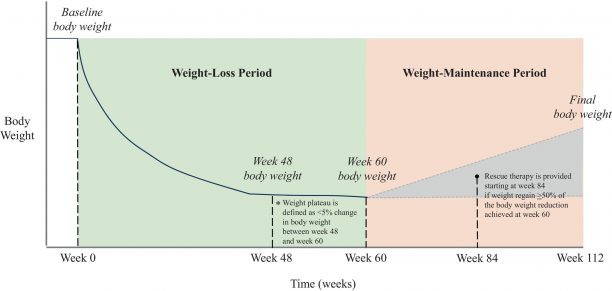
The trial followed people who had already lost a significant amount of weight on Mounjaro at the maximum dose (10 mg or 15 mg per week). After about a year, they were split into three groups:
- One group stayed on the maximum dose
- One group stepped down to 5 mg
- One group switched to a placebo (a dummy injection)
The trial then watched what happened over the following year. Three findings stand out.
1. Most people had already plateaued before the trial even began
By around week 60 of treatment (just over a year), roughly 84% of participants had stopped losing weight. Their bodies had settled at a new weight, and they were no longer losing despite continuing the same injections at the same dose.
This is so common that the researchers actually built it into the trial design. They specifically chose to study people who had already plateaued, because they knew this is what happens to the majority.
2. Staying on the maximum dose barely moved the needle further
The group that continued on the highest dose for a second year lost, on average, only 0.2 to 0.8 kg more over those 52 weeks. That’s less than a kilo across an entire year. To put that in perspective, your weight naturally fluctuates more than that across a single day depending on what you’ve eaten, how hydrated you are, and so on.
So the medication, at maximum strength, was no longer producing real additional weight loss.
3. Most people remained clinically obese
Even after two full years on the highest dose, the average person in the study had a BMI of 31.1, still inside the medical definition of obesity, which starts at a BMI of 30.
This is hard news, but it’s important news. Mounjaro is a powerful medication, but for many people it does not bring weight all the way down to a “normal” BMI, even with the strongest dose, taken faithfully, for years.
Why Does This Happen? A 300,000-Year-Old Reason
The short answer: your body is doing exactly what evolution designed it to do.

GLP-1 is a hormone your gut already makes, naturally. Mounjaro works by mimicking and amplifying it. But here’s the key thing to understand:

Naturally, your body releases GLP-1 in short bursts. When you eat a meal, your gut sends out a quick pulse of GLP-1, your brain receives a “you’ve had enough” signal, and within a couple of hours the hormone has cleared from your bloodstream. Pulse, signal, gone. That’s the design.
Humans have been doing this for around 300,000 years. Every brain in every generation evolved against a backdrop of brief, sharp, meal-by-meal GLP-1 pulses.
Mounjaro works completely differently. A single weekly injection produces a steady, round-the-clock flood of GLP-1-like signal, 24 hours a day, 7 days a week, for as long as you keep using it. Your brain has never experienced anything like this in our entire evolutionary history.
In the early months, it’s overwhelmed (in a good way). Hunger drops, food becomes less interesting, you eat less almost without trying, and the weight comes off. This is why Mounjaro is so effective at first.
But your brain is very good at one thing above all else: adapting. Faced with a signal that never goes away, it gradually adjusts. It quietly turns down the volume on the receptors that “hear” the medication. It recalibrates what it considers normal. And by around month 12 to 15, it has caught up.
That’s the plateau. It’s not your fault, and it’s not the drug failing. It’s your brain successfully adapting to something it was never designed to encounter.
The Medication’s Job Quietly Changes
Here’s the part that’s rarely explained clearly:
Once you’ve plateaued, Mounjaro is no longer helping you lose weight. It’s helping you not regain it.
This is a huge shift. Before the plateau, the drug is actively pushing your weight down. After the plateau, the same drug at the same dose is doing equally hard work, but now all of that work is going into defending your current weight against your body’s strong natural pull to regain.
Think of it like a brake on a hill. Early on, the brake is slowing the car down. Later, the car has come to rest, but the brake is still holding it in place against gravity. Let go of the brake, and the car rolls backwards.
That’s why people in the trial who stepped down to a lower 5 mg dose regained around 6 kg on average. And it’s why those who stopped the medication completely regained much more. Their bodies hadn’t been “cured” of anything. They’d been held in place by the medication, and removing it removed the brake.
What This Means for You
A few honest, practical takeaways:
Your plateau is normal. If your weight loss has stalled after 12–18 months, you’re following the textbook pattern. You don’t need to feel like you’ve failed. The trial data shows this is what happens to the great majority of people.
Pushing the dose higher won’t usually fix it. If you’re already on the maximum tolerated dose, asking for more isn’t likely to unlock more loss. The biology has reset, and more drug doesn’t undo that reset.
The medication is still doing important work. Staying on Mounjaro after the plateau isn’t pointless. It’s actively protecting the weight loss you achieved. Stopping or significantly reducing the dose carries a real, well-documented risk of regaining a substantial amount.
Weight loss isn’t the only benefit. Even if the scale isn’t moving, the medication continues to improve blood sugar control, reduce risk of type 2 diabetes, and lower cardiovascular risk for many people. Those benefits don’t plateau the way weight does.
Be cautious about “drug holidays.” Stopping the medication, even temporarily, often triggers significant regain. If you ever need to come off Mounjaro for cost, supply, or medical reasons, that’s a conversation worth having carefully with your prescriber, ideally with a plan in place. In fact, NowPatient offers it’s Mounjaro patients with a free 12 month cessation program, that helps patients to understand what to expect and how to adapt when coming off Mounjaro or other GLP-1 medications.
Mounjaro is rarely a complete answer on its own. For most people, the medication brings them part of the way (sometimes a long way), but not all the way to a “normal” BMI. That’s not a reason to dismiss it. It’s a reason to keep working alongside it: with realistic expectations, with food choices and exercise that protect your health, and with honest conversations about what success actually looks like for you.
What’s Coming Next
The good news is that researchers and drug developers now understand the plateau problem clearly, and several next-generation treatments are designed specifically to push past it.
Triple-hormone medications. Drugs like retatrutide target three different gut and metabolic hormones at once (instead of one or two). Early trial results show weight loss continuing further into year two, which is exactly what’s needed to break through the plateau.
Combination therapies. CagriSema (cagrilintide combined with semaglutide) and MariTide pair GLP-1 medications with a different hormone called amylin. Engaging two separate “fullness” systems at once may produce deeper, longer-lasting effects.
Body-composition drugs. Some new medications focus less on the scale and more on what kind of weight you keep. They help preserve muscle while you lose fat, which improves your long-term metabolic health regardless of BMI.
Smarter dosing schedules. Researchers are also exploring whether how the medication is delivered (a steady stream versus more natural pulses) might prevent the brain from adapting in the first place.
None of these are a magic cure, and they all still need to prove themselves in large trials. But the next five years of obesity medicine will look meaningfully different from the last five.
The Bottom Line
Mounjaro is one of the most effective weight-loss medications ever developed. It has genuinely changed what’s possible for people living with obesity, and the health benefits, even after weight loss plateaus, are real and worth having.
But it’s not a switch that resets your body’s “target weight” permanently. It’s more like a powerful, daily counterforce against a system that has spent hundreds of thousands of years learning to defend its weight. As long as you take the medication, the counterforce stays in place. When you reduce or stop it, your body, predictably, pulls back.
Knowing this doesn’t make Mounjaro less valuable. It makes you a better-informed patient, one who knows what to expect, when to expect it, and how to make confident decisions about your treatment in partnership with your healthcare team.
If you’re plateauing, you haven’t hit a wall. You’ve hit a doorway. The question isn’t whether to keep going. It’s how to walk through it with realistic expectations and a plan that works for the long term.
If you’re a NowPatient member and want to talk through what your own plateau means for your treatment plan, our pharmacist team is here to help. Book a free weight loss cessation consultation through your account.
NowPatient has taken all reasonable steps to ensure that all material is factually accurate, complete, and current. However, the knowledge and experience of a qualified healthcare professional should always be sought after instead of using the information on this page. Before taking any drug, you should always speak to your doctor or another qualified healthcare provider.
The information provided here about medications is subject to change and is not meant to include all uses, precautions, warnings, directions, drug interactions, allergic reactions, or negative effects. The absence of warnings or other information for a particular medication does not imply that the medication or medication combination is appropriate for all patients or for all possible purposes.