What Is Eligard?

Overview
Eligard® (leuprolide acetate) is a prescription medicine used in the management of advanced prostate cancer. It belongs to a class of drugs known as gonadotropin-releasing hormone (GnRH) agonists, also called androgen deprivation therapy (ADT). By reducing the amount of testosterone produced by the body, Eligard can slow or stall the growth of prostate cancer cells, which depend on this hormone to replicate.
Eligard is manufactured by Tolmar, Inc. in the United States and has been available for over 20 years, accumulating a substantial body of clinical evidence supporting both its efficacy and safety profile.
Prostate cancer is the most diagnosed cancer in men in the United States in 2024, affecting 1 in 8 men over their lifetime. Globally, it is among the leading causes of cancer-related mortality in men.
How Does Eligard Work?
Prostate cancer cells rely on androgens — primarily testosterone — to grow and multiply. Eligard works by interfering with the hormonal signals that trigger testosterone production in the testicles.
As a GnRH agonist, Eligard initially stimulates the pituitary gland, but with continued use it downregulates GnRH receptors, causing testosterone levels to fall to castrate range — typically within 2 to 3 weeks of the first injection. This reduction in testosterone can slow tumour growth and, in many cases, shrink the tumour for a period of time.
Important: The Testosterone Flare
During the first few days after the initial injection, Eligard temporarily causes a brief surge in testosterone levels — a phenomenon called tumour flare. This can temporarily worsen symptoms such as bone pain, urinary symptoms, or neurological complications in some patients. Your doctor will discuss whether any additional medication is needed to manage flare at the start of treatment.
No Known Drug–Drug Interactions
An important clinical advantage of Eligard is its absence of known drug–drug interactions (DDIs). This is particularly relevant for patients who require multiple concurrent medications due to other conditions, such as cardiovascular disease, diabetes, or skin conditions — making Eligard a practical ADT choice for complex patients.
Dosing Options
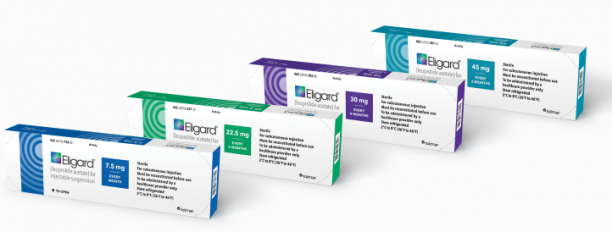
One of the key features of Eligard is its flexible dosing schedule. There are four dosing options available, allowing patients and their doctors to choose the injection frequency that best fits their lifestyle and treatment plan:
- 7.5 mg — administered once monthly (12 injections per year)
- 22.5 mg — administered once every 3 months (4 injections per year)
- 30 mg — administered once every 4 months (3 injections per year)
- 45 mg — administered once every 6 months (2 injections per year)

For many patients, the 6-month option is particularly appealing, reducing the treatment burden to just two clinic visits per year. All injections must be administered by a qualified healthcare professional in a clinical setting.
How is Eligard Administered?
Eligard is given as a subcutaneous (SC) injection — meaning the medication is injected with a short needle just beneath the skin, rather than into muscle. This minimally invasive approach:

- Can be administered anywhere on the body with sufficient subcutaneous tissue — not restricted to the abdomen
- Uses a needle measuring just 5/8 of an inch in length
- Avoids the local muscle soreness associated with intramuscular (IM) injections
- Is appropriate for patients with lower muscle mass, mobility challenges, or those taking anticoagulants
Extended-Release Technology
Eligard uses a proprietary extended-release delivery system called ATRIGEL®. After injection, the liquid formulation forms a small, biodegradable depot under the skin — roughly the size of a pea — which slowly releases the active drug over the intended dosing period. This ensures a consistent, continuous dose of leuprolide acetate is delivered to the body until the next scheduled injection.
Common Side Effects
As with all androgen deprivation therapies, Eligard may cause side effects related to testosterone reduction. The most commonly reported include:
- Hot flashes and night sweats
- Fatigue and weakness
- Testicular atrophy
- Decreased libido and erectile dysfunction
- Gynecomastia (breast tissue enlargement)
- Injection site reactions: burning, stinging, bruising, or redness
Longer-term use of ADT can also cause bone density loss. Patients should speak with their doctor about monitoring and managing bone health during treatment. See the full Prescribing Information and Important Safety Information for a complete list of risks and warnings.
Eligard in the United Kingdom
MHRA Approval
Eligard (leuprorelin acetate) is approved for use in the United Kingdom and holds a marketing authorisation granted by the Medicines and Healthcare products Regulatory Agency (MHRA). In the UK, the active ingredient leuprorelin acetate is recognised under its British Approved Name (BAN) and is indicated for the treatment of advanced, hormone-dependent prostate cancer in adult men.
Leuprorelin acetate — the active substance in Eligard — is classified as a prescription-only medicine (POM) in the UK and must be prescribed by a qualified clinician and administered by a healthcare professional.
Eligard on the NHS
Eligard may be prescribed within the NHS for eligible patients with advanced prostate cancer as part of an agreed treatment pathway. The availability and funding of specific ADT formulations can vary by NHS Trust and region. Patients should speak with their oncologist or urologist about which leuprorelin acetate formulation is available and most appropriate for them under NHS care.
UK Patients — What to Ask Your Doctor
- Is Eligard, or a leuprorelin acetate equivalent, available for my diagnosis?
- Which dosing schedule is most suitable for my lifestyle?
- What monitoring will be in place to track my testosterone and PSA levels?
- What can I do to manage bone density during long-term ADT?
Eligard in the United States
FDA Approval
Eligard was approved by the US Food and Drug Administration (FDA) on 24 January 2002 for the palliative treatment of advanced prostate cancer. It is among the most established ADT options in the US market and has consistently maintained one of the lowest wholesale acquisition costs (WACs) among GnRH agonists.
Understanding the Cost of Eligard
Cancer treatment in the United States can impose significant financial burdens on patients and their families. ADT medications like Eligard are typically administered in a physician’s office or clinic and billed under a medical benefit (Part B for Medicare patients), which means cost-sharing arrangements can differ significantly from retail prescription medications.
According to Tolmar, Eligard has not had a price increase in over 10 years, making it one of the most price-stable ADT options in the GnRH agonist market. Despite this, out-of-pocket costs can still be considerable depending on insurance coverage.
Changes to Medicare Part D in 2025
Medicare Part D underwent significant changes in 2025, including a new $2,000 annual cap on out-of-pocket prescription drug costs. However, patients may still experience higher monthly premiums, changes in formulary coverage, and fewer plan options. Eligard, administered in a clinical setting, generally falls under Medicare Part B rather than Part D — making it important for patients to understand their specific plan’s cost-sharing structure.
Financial Assistance Programmes for Eligard
A range of financial assistance options may be available to help eligible US patients manage the cost of Eligard treatment. The following resources are listed on eligard.com for informational purposes:
- BenefitsCheckUp® (benefitscheckup.org) — helps patients identify benefit programmes they may qualify for
- Cancer Financial Assistance Coalition (CFAC) (cancerfac.org) — a coalition of organisations offering financial assistance to cancer patients
- CancerCare® Co-Payment Assistance Foundation (cancercarecopa.org) — provides co-payment assistance for eligible patients
- HealthWell Foundation® (healthwellfoundation.org) — offers grants to help with medication costs and insurance premiums
- Medicine Assistance Tool (medicineassistancetool.org) — a resource to help patients find manufacturer patient assistance programmes (PAP)
- Patient Advocate Foundation (copays.org) — assists with co-pay costs and financial advocacy
Patient Assistance Programmes (PAP) and Copay Support
Many patients prescribed Eligard may be eligible for financial support through a Patient Assistance Programme (PAP), which can significantly reduce or eliminate the cost of treatment for qualifying individuals. Copay cards and co-insurance support may also be available depending on the patient’s insurance type and income level.
US patients: Use the NowPatient Drug Savings Eligibility Checker to find out if you qualify for a Patient Assistance Programme, copay card, or other savings options for Eligard and hundreds of other medications — at no cost to you.
Visit NowPatient Drug Savings to check your eligibility for Eligard cost savings today.
Who is Eligard For?
Eligard is indicated for adult men with advanced prostate cancer. It may be prescribed in the following contexts:
- Metastatic prostate cancer (cancer that has spread beyond the prostate)
- Locally advanced prostate cancer where hormone therapy is appropriate
- As an adjunct to radiotherapy for high-risk localised or locally advanced prostate cancer
- Biochemical recurrence following primary treatment, where ADT is clinically indicated
Eligard is not suitable for women or children, and should not be used by anyone with a known hypersensitivity to leuprolide acetate or other GnRH agonists.
Questions to Ask Your Doctor Before Starting Eligard
- Is Eligard the most appropriate ADT for my stage and type of prostate cancer?
- Which dosing interval suits my health needs and lifestyle best?
- How will my testosterone and PSA levels be monitored?
- What side effects should I watch for, and when should I contact you?
- How can I protect my bone health during ADT?
- Are there any other medications I am taking that could interact with Eligard?
- What financial support is available to help with the cost of treatment?
Save on Eligard with NowPatient
NowPatient is a prescription services platform operating in the UK, US & worldwide. NowPatient offers drug savings tools for patients in the US. Our free Drug Savings Eligibility Checker can help US patients identify whether they qualify for:
- Patient Assistance Programmes (PAP) that may provide Eligard at no or low cost
- Manufacturer copay support cards
- Independent charitable assistance funds
- Medicare Extra Help and other government-funded programmes
Check your eligibility in minutes — visit nowpatient.com or search ‘Eligard’ in our drug savings tool to get started.
Important Safety Information
Important Safety Information: ELIGARD® is indicated for the treatment of advanced prostate cancer. It is a prescription medication that must be administered by a healthcare professional. ELIGARD is not suitable for everyone. It may cause a temporary rise in testosterone (tumour flare) in the first few weeks of treatment. Serious risks include increased risk of heart attack, stroke, and sudden cardiac death; QTc interval prolongation; elevated blood sugar and increased risk of diabetes; convulsions; and rare severe skin reactions. The most common side effects include hot flashes, fatigue, testicular atrophy, and injection site reactions. Always discuss the full benefits and risks with your prescribing doctor. Report side effects to the MHRA Yellow Card Scheme (UK) or FDA MedWatch (US).
For full prescribing information, visit eligard.com. This article is for informational purposes only and does not constitute medical advice. Always consult your doctor or specialist before starting, stopping, or changing any medication.
Sources
- Eligard.com — Official patient website (Tolmar, Inc.)
- MHRA — Medicines and Healthcare products Regulatory Agency, UK
- American Cancer Society — Cancer Facts & Figures 2025
- NCCN Guidelines for Patients® — Advanced-Stage Prostate Cancer, National Comprehensive Cancer Network, 2024
- Wikipedia: Leuprorelin — pharmacology and regulatory history
- EMA: Leuprorelin-containing depot medicines Article-31 referral (2020)
NowPatient has taken all reasonable steps to ensure that all material is factually accurate, complete, and current. However, the knowledge and experience of a qualified healthcare professional should always be sought after instead of using the information on this page. Before taking any drug, you should always speak to your doctor or another qualified healthcare provider.
The information provided here about medications is subject to change and is not meant to include all uses, precautions, warnings, directions, drug interactions, allergic reactions, or negative effects. The absence of warnings or other information for a particular medication does not imply that the medication or medication combination is appropriate for all patients or for all possible purposes.