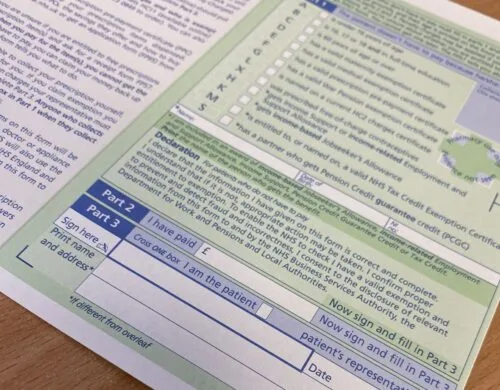
NHS prescription exemption changes 2026: Free NHS prescriptions are changing
What you need to know before April 2026
From 15 April 2026, significant changes to NHS prescription charge exemptions will take effect in England. Two long-standing benefit categories Income Support and Income-based Jobseeker’s Allowance (JSA) will cease to be valid prescription exemption categories. The government announced a freeze on NHS prescription charges for 2025/26, and these changes are part of broader efforts to freeze prescription charges and update exemption categories.
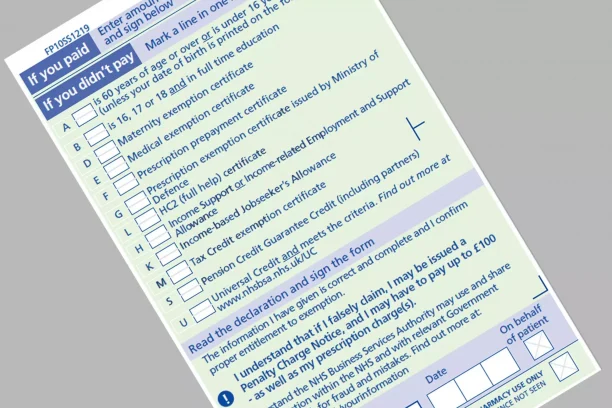
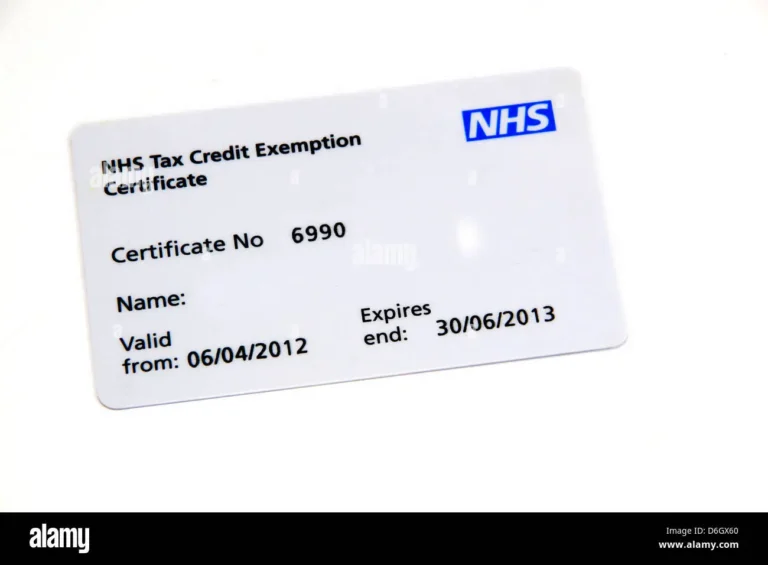
These changes follow the abolition of Tax Credits in April 2025 and form part of the Government’s ongoing migration of legacy benefits to Universal Credit. The transition from legacy benefits to Universal Credit will affect access to free NHS prescriptions for many individuals.
This guide explains who is affected, what the new rules mean, what action patients should take, and which exemption categories remain in place. Understanding NHS prescription charges and exemption categories is crucial for patients affected by these changes. It is based on guidance from Community Pharmacy England (updated March 2026) and the NHS Business Services Authority (NHSBSA).
Critical date: 15 April 2026
Prescriptions dispensed on or before 14 April 2026 may still be claimed using Income Support (Box H) or Income-based JSA (Box K) as the exemption reason. Prescriptions dispensed on or before this date with a declaration for the Income Support or Income-based Jobseeker’s Allowance exemption will continue to be treated as exempt, even if submitted for payment after this date. The reverse of FP10 prescription forms and EPS tokens will be updated to remove the Income Support and Income-based Jobseeker’s Allowance exemption categories. From 15 April 2026 onwards, these exemption categories are no longer valid regardless of circumstances.
What is changing and why?
Income Support and income-based JSA are being abolished
The Department for Work and Pensions (DWP) is abolishing both Income Support and Income-based Jobseeker’s Allowance as part of the long-running migration to Universal Credit. As a direct consequence, these benefits can no longer serve as valid NHS prescription charge exemption categories after 14 April 2026.
While Income Support and Income-based JSA will no longer be valid for exemption, support allowance remains as an exemption factor for those on Income-related Employment and Support Allowance (ESA). Receiving certain benefits, such as Income Support or Income-based JSA, will also no longer automatically entitle people to free NHS prescriptions after the transition period.
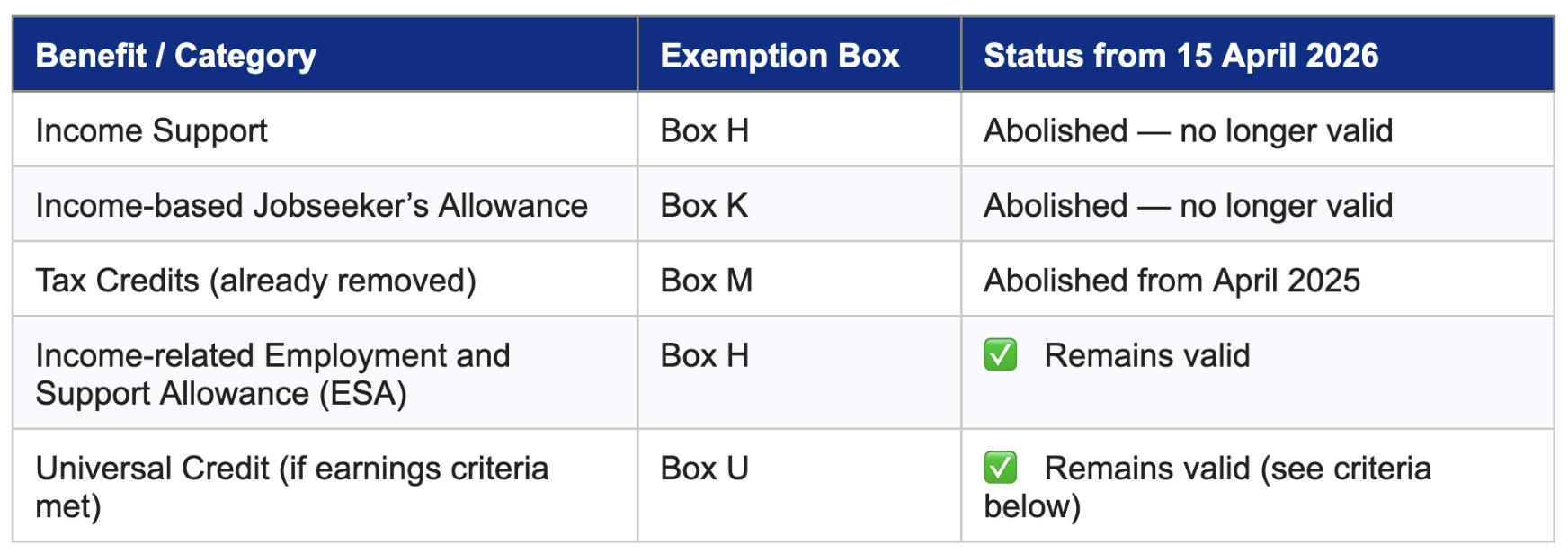
Changes for NHS prescription exemptions from 15 April 2026.
This is part of a broader pattern. Tax Credits, which also provided prescription exemption entitlement, were already abolished in April 2025. Income Support and Income-based JSA are the next benefits to be removed from the exemption framework.
Why this affects more people than expected
Many patients have already been moved to Universal Credit from Tax Credits or other legacy benefits. However, eligibility for free NHS prescriptions will depend on the last complete assessment period for benefit claims. The complete assessment period is used to verify ongoing eligibility for exemption. Simply receiving Universal Credit does not automatically entitle a patient to free prescriptions. The new earnings thresholds under Universal Credit are considerably lower than those that applied under the old Tax Credits system
Earnings threshold comparison
Under Tax Credits – equivalent to approximately £1,210/month take-home
Under Universal Credit (standard) – £435/month take-home
Under Universal Credit (with child element or LCW/LCWRA) – £935/month take-home
Many patients who qualified for free prescriptions under Tax Credits will no longer qualify under Universal Credits, even if their income has not changed.
The Universal Credit earnings test (box U)
Universal Credit (Box U) does entitle patients to free NHS prescriptions, but only where a specific earnings test is met. Simply being in receipt of Universal Credit is not sufficient.
The eligibility test is based on the patient’s take-home pay — after deductions for income tax, National Insurance, and pension contributions — during their most recent Universal Credit assessment period.
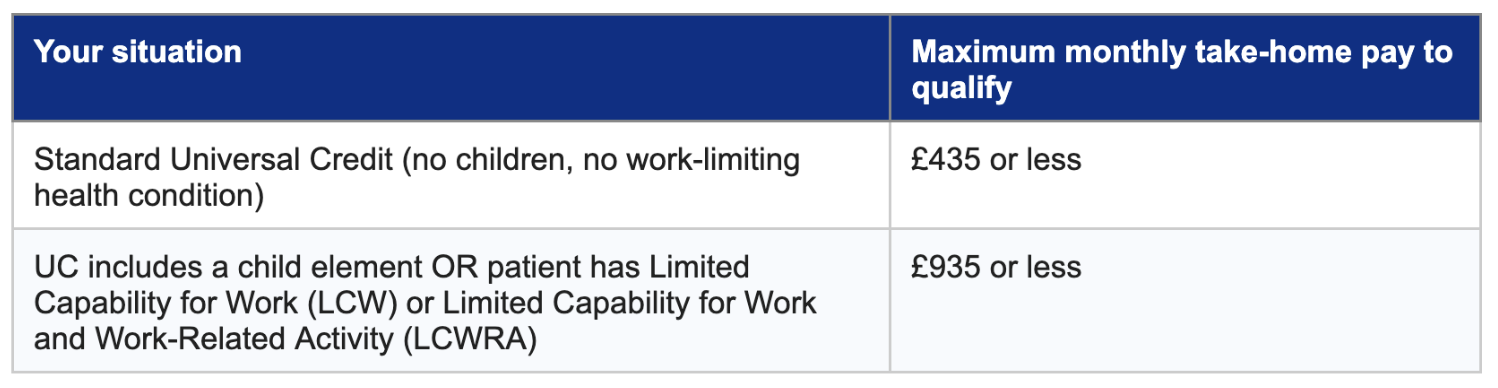
For couples, this earnings limit applies to the combined joint take-home pay of both the patient and their partner.
The ‘most recent assessment period’ runs for one calendar month from the date of the original Universal Credit claim. Earnings are assessed fresh each month, which means eligibility for free prescriptions can change from one month to the next depending on income.
Important: Being named on a Universal Credit award does not in itself confer any entitlement to free prescriptions. Entitlement is dependent entirely on the earnings figure for the most recent assessment period.
Important note on box H: Income-related ESA vs Income Support
Both Income Support and Income-related Employment and Support Allowance (ESA) previously used the same box Box H on the prescription form. This is now an important distinction:
Only patients in a valid exemption category, such as those receiving Income-related ESA, will continue to qualify for free NHS prescriptions after April 14, 2026. Patients receiving legacy benefits can claim free prescriptions only until April 14, 2026.

Patients who are in receipt of Income-related ESA should continue to select Box H as normal. Patients who were on Income Support and have since been moved to Universal Credit should check whether they meet the UC earnings test (Box U) before claiming a free prescription.
If a patient is unsure which benefit they are receiving, they should check their most recent award letter or log in to their benefits account at gov.uk.
Complete guide to current exemption categories
The following categories remain valid from 15 April 2026 onwards. Unless otherwise noted, all categories below are unaffected by the April 2026 changes.
- The upper age exemption for free NHS prescriptions remains at 60, despite proposals to raise it to 66.
- Free NHS prescriptions are available to individuals who are under 16, aged 60 or over, have a valid Medical Exemption Certificate for specific medical conditions, or hold a valid Maternity Exemption Certificate.
- Pregnant women are eligible for free prescriptions with a valid Maternity Exemption Certificate.
- Young people leaving care will be entitled to free prescriptions up to age 25, pending legislative updates.
- Individuals are entitled to free prescriptions if they hold a valid HC2 certificate for full help with health costs.
- Patients with certain medical conditions can apply for a medical exemption certificate from their GP to be exempt from prescription charges.
- Free prescriptions are available for all residents in Scotland, Wales, and Northern Ireland.
- Social care services play a key role in supporting vulnerable populations who may qualify for prescription exemptions, ensuring integration of health and social care to improve patient outcomes.












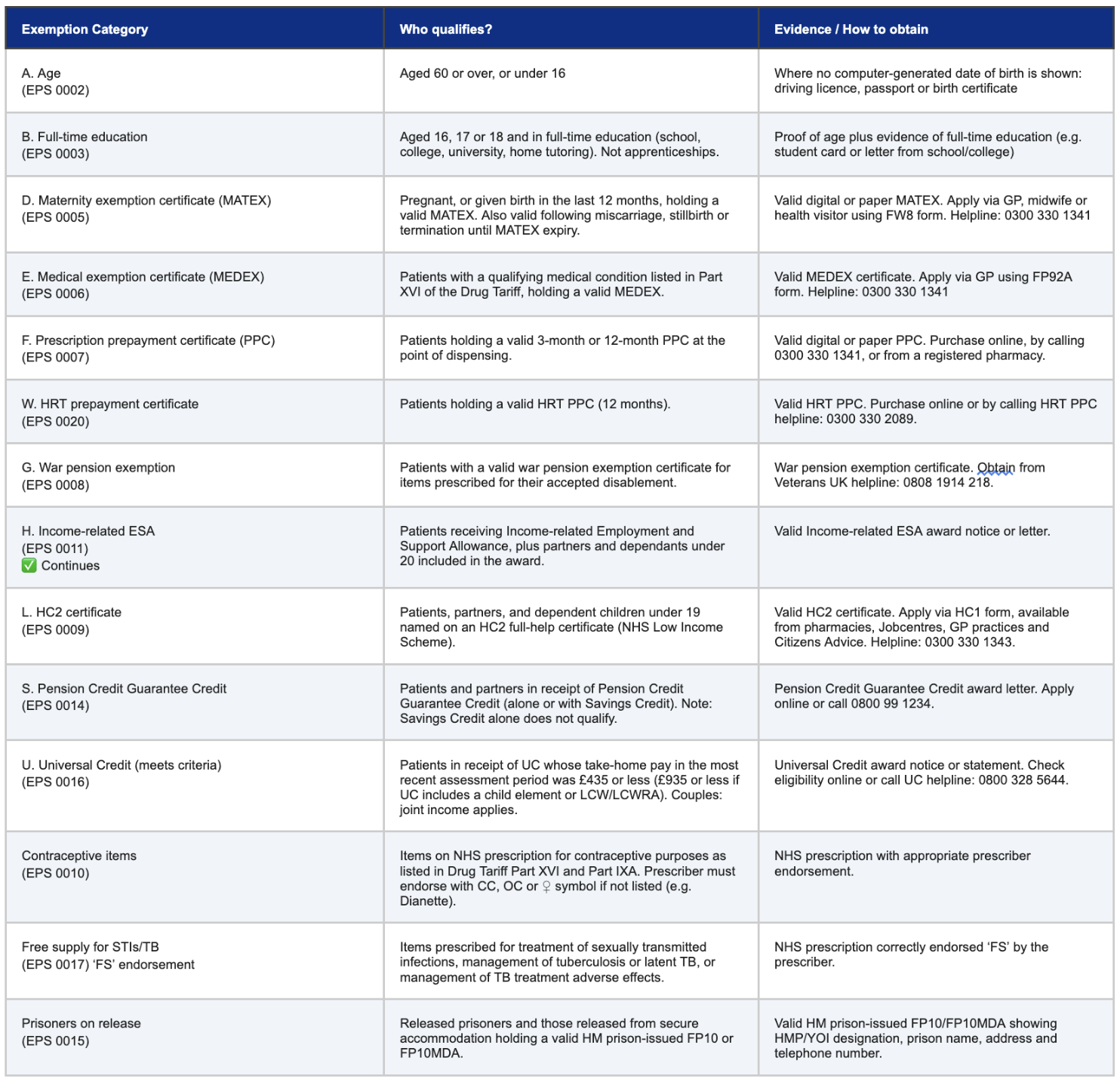
Exemptions for NHS prescriptions 2026
Penalty charges for incorrect exemption claims
The NHSBSA runs regular checks to verify that patients claiming free prescriptions are entitled to do so. Patients must have a valid basis for claiming exemption and must accurately declare their exemption status on prescription forms. If a patient is found to have claimed incorrectly, a Penalty Charge Notice (PCN) may be issued.
How the penalty charge works
- The patient is charged the original prescription charge they should have paid
- An additional penalty is applied which can be five times the cost of the original prescription charge, up to a maximum of £100
- At the current prescription charge of £9.90 per item, the additional penalty alone would be £49.50
- The NHSBSA typically sends an enquiry letter first; if the patient does not respond within 28 days, the PCN is issued
- Claiming ignorance of the rule change, including being advised by a pharmacy that an exemption was still valid, is generally not accepted as a defence
The scale of incorrect claims
According to data obtained under a Freedom of Information request, over 660,000 Penalty Charge Notices were issued in 2024/25 which is a 17% increase on the previous year. Of these, more than 113,000 were issued to patients who had ticked benefits exemption boxes without being eligible, a 632% increase on 2023/24. A significant proportion of these cases are linked to patients who moved from Tax Credits to Universal Credit and did not realise the rules had changed.
What patients should do now: a step-by-step guide
Step 1: Check whether you still qualify
Use the free NHSBSA eligibility checker to find out whether you are entitled to free prescriptions under your current circumstances. You will need details of your benefit award which you can check on the NHSBA website
Step 2: Check your Universal Credit assessment period earnings
If you receive Universal Credit, log in to your UC account and review your most recent assessment period. Check your take-home pay after tax and National Insurance. Compare this against the £435 threshold (or £935 if you have a child element or LCW/LCWRA).
Step 3: If unsure, pay and request an FP57 refund form
If you are uncertain about your eligibility at the point of collecting your prescription, the safest approach is to pay the prescription charge and ask the pharmacy for an FP57 receipt and refund form. You can then confirm your eligibility through the NHSBSA checker and, if entitled, claim a refund at any community pharmacy. Refund claims can be submitted up to three months after payment.
Step 4: Consider a Prescription Prepayment Certificate (PPC)
If you no longer qualify for free prescriptions but you take more than one prescription item per month, a PPC may significantly reduce your costs. Annual prescriptions prepayment certificates are also included in the freeze on prescription charges, providing financial relief and convenience for frequent medication users. A 12-month PPC allows you to collect all of your NHS prescriptions for a fixed annual fee, regardless of how many items you need. The cost of a single NHS prescription is currently £9.90 and will remain frozen until 1 April 2026. Both the prescription charge and annual prescriptions prepayment certificates will remain frozen for this period. Check the current price at nhsbsa.nhs.uk.
Ordering NHS prescriptions through NowPatient
If you order your NHS prescriptions through NowPatient, your exemption declaration remains your legal responsibility as the patient. When you select an exemption category during your order, you are making a formal declaration that you are entitled to claim free prescriptions on that basis. Pharmacists play a key role in verifying exemption status and ensuring that prescription forms are completed accurately.
We recommend the following steps before placing your next order:
- Check your eligibility before ordering if you were previously claiming under Income Support or Income-based JSA
- Use the NHSBSA eligibility checker to confirm your current status
- Update your exemption declaration on your NowPatient account to reflect your current benefit status
- If you are unsure, select ‘I will pay’ rather than claiming an exemption you are not confident about
Need help? If you receive your prescription and later confirm that you were entitled to a free prescription, you may be able to claim a refund. Contact the NowPatient support team and we can guide you through the process. You can also present your FP57 form with evidence of benefit entitlement at any community pharmacy.
Quick reference summary
Key points from 15 April 2026
- Income Support (Box H) — no longer a valid prescription exemption
- Income-based JSA (Box K) — no longer a valid prescription exemption
- Income-related ESA (Box H) — continues to be valid
- Universal Credit (Box U) — only qualifies if take-home pay was £435/month or less (£935 in some cases)
- Tax Credits (Box M) — already removed in April 2025
- Incorrectly claiming free prescriptions can result in a penalty charge of up to £100
- If unsure: pay, take an FP57 form, and claim a refund once eligibility is confirmed
Further information and useful links
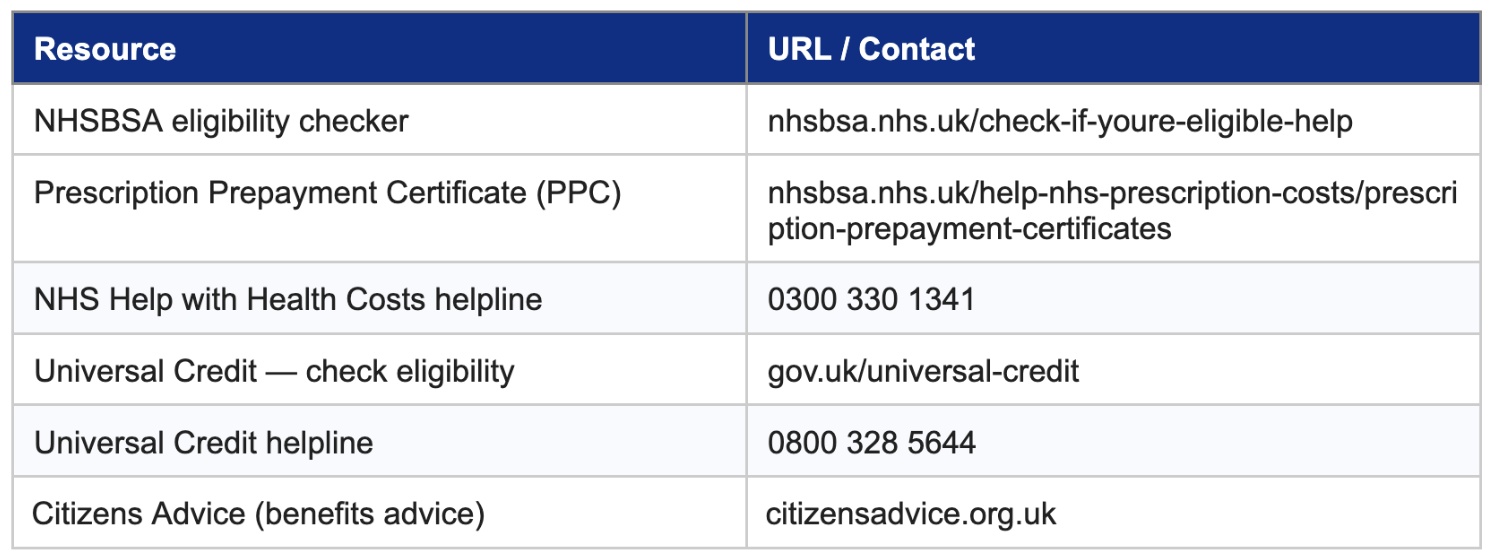
Table showing useful resources