





















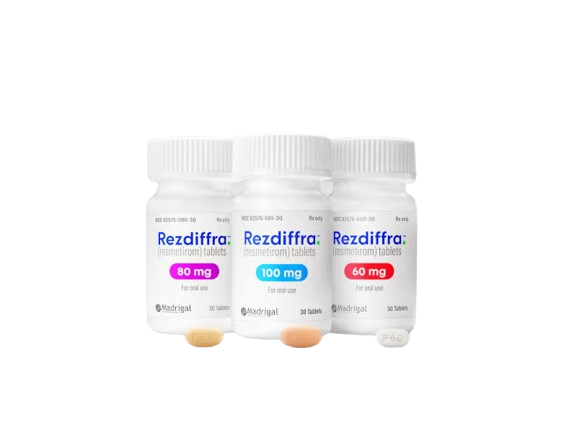
Rezdiffra is a prescription-only medicine and is not available over the counter. As a once-daily, oral, liver-directed thyroid hormone receptor (THR)-β agonist, it must always be used alongside dietary improvements and regular exercise. It is not a standalone therapy and is not a replacement for lifestyle management.
How does Rezdiffra work?
In patients with MASH, a protein in liver cells called the thyroid hormone receptor-beta (THR-β) does not function properly. THR-β plays an important role in regulating how the liver breaks down fat. When it is impaired, fat accumulates in the liver, contributing to the inflammation, cell damage, and fibrosis that define MASH.
Resmetirom works by binding to and activating THR-β specifically in liver cells (hepatocytes). By doing so, it restores the signalling pathway that stimulates fat breakdown (a process known as beta-oxidation and lipid metabolism). This results in:
- a reduction in liver fat (hepatic steatosis)
- reduced liver inflammation
- a slowing or reversal of liver fibrosis
- improved overall liver function
Importantly, resmetirom is designed to act selectively in the liver, with approximately 28-fold selectivity for THR-β over THR-α – the receptor subtype found in the heart and other tissues. This selectivity helps minimise the systemic thyroid-like effects (such as cardiac effects) that would otherwise be a concern with thyroid hormone-based treatments.
The drug evaluation process included assessment of Rezdiffra’s selective activation of THR-β and its impact on liver fat and fibrosis in clinical trials.
Source: European Medicines Agency (EMA) — Rezdiffra European Public Assessment Report (EPAR), 2025. www.ema.europa.eu
What is the evidence for Rezdiffra?
The MAESTRO-NASH trial
The pivotal clinical evidence for Rezdiffra comes from the MAESTRO-NASH trial, a large Phase 3, randomised, placebo-controlled study. The trial involved 917 adult patients treated with MASH and liver fibrosis at stage F2 or F3. Participants received either 80 mg resmetirom, 100 mg resmetirom, or a placebo (dummy treatment) for 12 months, allowing for direct comparison between the treatment and placebo groups.
The trial measured two primary endpoints:
- Resolution of MASH symptoms (improvement or disappearance of inflammation and hepatocyte ballooning), with no worsening of fibrosis
- Improvement in liver fibrosis by at least one stage, with no worsening of MASH
Key results (at 12 months):
| Outcome | Rezdiffra (80–100 mg) | Placebo |
|---|---|---|
| MASH resolution with no worsening of fibrosis | 26–30% | 10% |
| Fibrosis improvement with no worsening of MASH | 27–29% | 17% |
In a clinical trial, Rezdiffra improved fibrosis by at least one stage in 24% to 26% of patients compared to 14% in the placebo group.
Rezdiffra demonstrated improvements in liver stiffness, liver enzymes, and lipids in patients with compensated MASH cirrhosis. In the Phase 3 MAESTRO-NAFLD-1 trial, Rezdiffra showed statistically significant improvements in health-related quality of life measures in patients with compensated MASH cirrhosis. The FDA approved Rezdiffra under the accelerated approval pathway based on improvements in NASH and fibrosis.
These results were considered clinically meaningful by the EMA’s Committee for Medicinal Products for Human Use (CHMP). The EMA noted that at the time of Rezdiffra’s approval, no other authorised treatment for MASH existed, representing a significant unmet medical need.
The most common side effects of Rezdiffra included diarrhea and nausea. In clinical trials, Rezdiffra included diarrhea as a notable, though manageable, side effect.
It is important to note that, as of the time of approval, long-term data on whether these improvements translate into reductions in liver transplantation rates, liver-related mortality, or overall survival had not yet been established. Ongoing studies are expected to provide this evidence.
Source: European Medicines Agency (EMA) — Rezdiffra EPAR and CHMP meeting highlights, June 2025. www.ema.europa.eu
What are the side effects of Rezdiffra?
Like all medicines, Rezdiffra can cause side effects. The following information is drawn from the EMA’s approved product information.
Very common side effects (affecting more than 1 in 10 people):
- Diarrhoea – typically occurs at the start of treatment, is mild to moderate in severity, and resolves on average within 2 to 3 weeks
- Nausea (feeling sick)
Common side effects (affecting up to 1 in 10 people):
- Pruritus (itching)
Uncommon side effects (affecting up to 1 in 1,000 people):
- Cholecystitis (inflammation of the gallbladder, often caused by gallstones blocking the bile duct)
- Urticaria (itchy rash)
Gallbladder-related side effects, such as cholelithiasis and cholecystitis, have been associated with Rezdiffra.
Rezdiffra may cause liver toxicity, and healthcare providers will monitor patients for increases in liver enzyme levels and liver-related side effects. Patients with NASH should be monitored for liver enzyme levels and liver-related side effects while taking Rezdiffra. Patients should stop using Rezdiffra if they develop signs or symptoms of worsening liver function while on treatment.
Rezdiffra may also interact with certain other medicines. In particular, it can increase the blood levels of some statins (cholesterol-lowering medicines), including atorvastatin, pravastatin, rosuvastatin, and simvastatin. This may increase the risk of statin-related side effects, such as muscle pain. Dose adjustments for certain statins may be needed when taken alongside Rezdiffra. Monitoring is important when Rezdiffra is used with statins for lowering cholesterol to avoid potential drug interactions and adverse effects.
Rezdiffra should not be taken together with gemfibrozil (a strong inhibitor of the CYP2C8 enzyme), as this can significantly affect how Rezdiffra is processed in the body.
For detailed guidance on medication use, dosage, safety warnings, and potential drug interactions, always refer to the official prescribing information.
Monitoring and safety measures are in place to protect patients from adverse effects and disease progression. Managing liver health requires a combination of medication, diet, and exercise.
Important warning: Patients should consult their healthcare provider before using Rezdiffra during pregnancy due to potential risks to the unborn baby. It is also important to discuss breastfeeding and the safety of breast milk while taking this medication.
For a full list of side effects, contraindications, and drug interactions, refer to the EMA-approved Summary of Product Characteristics (SmPC).
Source: European Medicines Agency (EMA) — Rezdiffra product information (SmPC and package leaflet). www.ema.europa.eu
Who is Rezdiffra for, including patients with advanced liver fibrosis?
According to EMA-approved product information, Rezdiffra is indicated for:
| Adults with noncirrhotic metabolic dysfunction-associated steatohepatitis (MASH) with moderate to advanced liver fibrosis (fibrosis stages F2 to F3), used in conjunction with diet and exercise. |
|---|
Rezdiffra is specifically indicated for patients with notable liver scarring and advanced liver scarring fibrosis due to MASH, addressing a critical need for those at risk of progression to cirrhosis and other severe complications.
It is not approved for patients with cirrhosis (stage F4 fibrosis) or decompensated liver disease. It is not indicated for use in children or adolescents under 18 years of age.
Administration and storage
Proper administration and storage of Rezdiffra (resmetirom) are essential for achieving the best possible outcomes in the treatment of advanced liver scarring, nonalcoholic fatty liver disease, and metabolic dysfunction-associated steatohepatitis (MASH). Rezdiffra is taken orally once daily, with the recommended dosage determined by your body weight and individual health needs. It is important to follow your healthcare provider’s instructions closely, taking the medication at the same time each day, and always in combination with a healthy diet and regular exercise to help manage fatty liver disease and advanced liver fibrosis.
Before starting Rezdiffra treatment, inform your healthcare provider about all the medicines you are taking, including prescription drugs, over-the-counter medicines, vitamins, and herbal supplements. This is crucial because Rezdiffra can have potentially significant drug interactions, which may increase the risk of drug-induced liver toxicity or affect how your body processes other medications. Your healthcare provider will review your medical history, including any existing liver problems, to ensure Rezdiffra is safe and appropriate for you.
During treatment, regular monitoring is vital. Your healthcare provider may order blood tests and imaging tests, such as a liver biopsy, to assess liver function, track liver enzymes, and detect any signs of worsening liver function or liver damage. Monitoring helps identify any early signs of liver failure or gallbladder problems, and ensures that the clinical benefit of Rezdiffra is maintained. If you develop side effects of Rezdiffra, such as diarrhea, nausea, or symptoms related to gallbladder issues, report them promptly to your healthcare provider.
Rezdiffra tablets are available in 60 mg, 80 mg, and 100 mg strengths. Store the tablets at room temperature, between 68°F and 77°F (20°C to 25°C), in their original container. Protect the medication from light and moisture, and keep it out of reach of children and pets to prevent accidental ingestion. Do not use Rezdiffra if the packaging is damaged or if the tablets are expired. Dispose of any unused medication safely, following the instructions provided by your pharmacist or healthcare provider.
The continued approval of Rezdiffra depends on ongoing clinical trials that monitor its long-term effects on liver scarring, liver fat accumulation, and overall liver disease progression. The FDA granted accelerated approval to Rezdiffra based on its demonstrated clinical benefit in improving advanced liver fibrosis and reducing liver fat, but ongoing monitoring and adherence to recommended administration and storage guidelines are essential for patient safety.
By carefully following your healthcare provider’s advice on how to take and store Rezdiffra, and by attending all recommended monitoring appointments, you can help protect your liver health and reduce the risk of further liver injury or complications. Open communication with your healthcare team is key to managing your condition and achieving the best possible results with Rezdiffra treatment.
What is the regulatory and approval status in the UK?
European Medicines Agency (EMA)
Rezdiffra received a conditional marketing authorisation from the European Commission on 18 August 2025, valid throughout the European Union. This followed a positive opinion from the EMA’s CHMP in June 2025. The conditional authorisation was granted on the basis that the immediate public health benefit outweighs the risk of having less comprehensive data than would normally be required, a mechanism used when a medicine fulfils an unmet medical need.
As part of the conditional authorisation, the manufacturer is required to submit further results from ongoing studies to confirm long-term clinical benefit.
Source: EMA — Rezdiffra EPAR. www.ema.europa.eu/en/medicines/human/EPAR/rezdiffra
United States FDA
In the United States, Rezdiffra was granted accelerated approval based on clinical trial data showing promising biomarker and noninvasive imaging improvements. The approval was managed by the FDA’s Center for Drug Evaluation and Research (CDER). Continued approval may depend on further confirmatory trials to demonstrate clinical benefit.
United Kingdom MHRA
Following Brexit, the UK Medicines and Healthcare products Regulatory Agency (MHRA) operates independently from the EMA. EMA approval does not automatically apply in the United Kingdom. As of March 2026, no MHRA marketing authorisation for Rezdiffra has been publicly confirmed. Patients and healthcare professionals in the UK should check the MHRA’s product licence register for the most up-to-date information.
NICE Technology Appraisal in England
NICE is currently appraising resmetirom through its Technology Appraisal process (GID-TA11414 / ID6529), as part of a Multiple Technology Appraisal (MTA) alongside semaglutide for MASH with liver fibrosis.
The key dates for this appraisal are:
- Committee Meeting: 15 April 2026
- Expected guidance publication: 10 June 2026
Until NICE publishes a positive recommendation and MHRA grants a licence, Rezdiffra is not routinely available through the NHS in England. Patients should not attempt to source this medicine outside of established clinical pathways.
Source: NICE — Project information, Resmetirom for treating non-alcoholic steatohepatitis and liver fibrosis [ID6529]. www.nice.org.uk/guidance/indevelopment/gid-ta11414
Key facts about Rezdiffra at a glance
| Active substance | Resmetirom |
| Manufacturer | Madrigal Pharmaceuticals |
| Drug class | Thyroid hormone receptor-beta (THR-β) agonist |
| Indication (EMA-approved) | Noncirrhotic MASH with moderate to advanced liver fibrosis (F2–F3) in adults, with diet and exercise; also indicated for advanced liver disease |
| Route of administration | Oral tablet, once daily |
| Available doses | 80 mg and 100 mg |
| EU approval status | Conditional marketing authorisation granted 18 August 2025 (EMA / European Commission) |
| UK (MHRA) status | Not confirmed as of March 2026 — check MHRA register |
| NHS availability (England) | NICE appraisal in progress; guidance expected June 2026 |
| Prescription status | Prescription-only medicine (POM) |
Note: Rezdiffra is the first drug approved for the treatment of MASH and advanced liver disease. It received accelerated approval based on improvements in NASH and fibrosis.
References
1. European Medicines Agency (EMA). Rezdiffra (resmetirom) — European Public Assessment Report (EPAR). Available at: www.ema.europa.eu/en/medicines/human/EPAR/rezdiffra [Accessed March 2026].
2. European Medicines Agency (EMA). First treatment against liver scarring caused by a type of ‘fatty liver disease’. News announcement, June 2025. www.ema.europa.eu
3. European Medicines Agency (EMA). Meeting highlights from the CHMP, 16–19 June 2025. www.ema.europa.eu
4. National Institute for Health and Care Excellence (NICE). Resmetirom for treating non-alcoholic steatohepatitis and liver fibrosis [ID6529]. GID-TA11414. Available at: www.nice.org.uk/guidance/indevelopment/gid-ta11414 [Accessed March 2026].