What Is Axhidrox (glycopyrronium Bromide Cream)?

Understanding Primary Axillary Hyperhidrosis
Primary axillary hyperhidrosis (PAHH) is a condition in which sweating of the underarms exceeds that required for normal thermoregulatory function. It is classified as “primary” when the excessive sweating originates independently, rather than as a consequence of another condition, medication, or systemic disorder. A score of 3 or 4 on the Hyperhidrosis Disease Severity Scale (HDSS) indicates severe PAHH, meaning sweating is barely tolerable or intolerable and frequently or always interferes with daily activities.

The impact on patients extends well beyond the physical. The condition affects life choices, employment, and friendships. Only around half of people with the condition seek help from healthcare professionals because of embarrassment. Patient experience also reflects that effective treatment could help reduce social anxiety, enabling people to fully participate in work and social life, with a substantial positive impact on emotional wellbeing and self-esteem.

The NHS Management Pathway
PAHH is initially managed in primary care. People are offered lifestyle advice, and causes of secondary hyperhidrosis, such as another condition or a side effect of medication, are excluded. Topical treatment with 20% aluminium chloride hexahydrate preparations (aluminium-based antiperspirants) may be tried, though these are not prescribed on the NHS and people are signposted to community pharmacies to buy them.
If initial treatment does not adequately control sweating, people may be offered an oral anticholinergic. If the condition cannot be managed well enough in primary care, referral to secondary care follows, where oral anticholinergics may also be offered alongside botulinum toxin type A in some centres.
Clinical experts have noted that oral anticholinergics carry a range of burdensome side effects including dry mouth, constipation, blurred vision, and dry eyes, which can affect the ability to drive or operate heavy machinery. Only some NHS trusts offer botulinum toxin, meaning this option is unavailable to many patients, and there can be restrictions on the number of treatments permitted per year.
Propantheline bromide is the only oral anticholinergic with a licence for hyperhidrosis in the UK, making it the relevant first-line oral comparator in primary care. In secondary care, modified-release oxybutynin and botulinum toxin type A are the main alternatives.
What is Axhidrox?
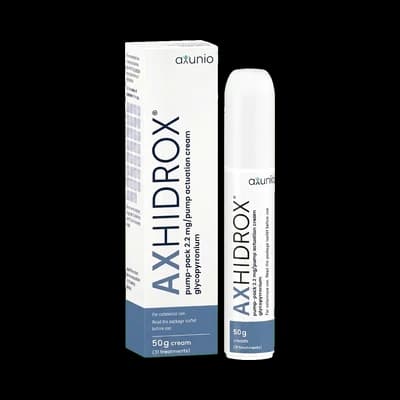
Axhidrox is a pump-pack cream containing glycopyrronium bromide. Each gram of cream contains glycopyrronium bromide equivalent to 8 mg of glycopyrronium. One actuation of the pump delivers 270 mg of cream, containing 2.2 mg glycopyrronium.
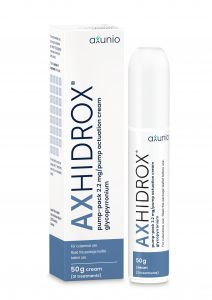
Axhidrox is indicated for the topical treatment of severe primary axillary hyperhidrosis in adults.
Axhidrox received a UK marketing authorisation in June 2025 (PL 47848/0056, authorised 9 June 2025, held by axunio Pharma GmbH). The product is available from the NHS in the UK from May 2026. It is also available from NowPatient.
Axhidrox has been authorised and commercially available in a number of other European countries since 2022, providing a longer track record of use in comparable healthcare systems.
Mechanism of Action
Glycopyrronium is a competitive antagonist of the muscarinic acetylcholine receptors. It inhibits acetylcholine-driven effects on smooth muscle, heart muscle cells, and various glands, including the sweat glands. In the sweat glands, this results in a reduction in perspiration.

Eccrine sweat glands express various muscarinic acetylcholine receptor subtypes and can be activated by acetylcholine and effectively blocked by muscarinic antagonists. Glycopyrronium bromide is a muscarinic antagonist with a high affinity for M3 receptors, and secretion of sweat from the sweat glands is predominantly mediated by those receptors.
This pharmacological action distinguishes Axhidrox from conventional cosmetic antiperspirants, which act by a physical occlusive mechanism on sweat ducts rather than by reducing the underlying neurochemical signal to the gland.
Posology and Method of Administration
Dose
The recommended dosage of Axhidrox is two pump actuations per armpit, equivalent to 540 mg of cream or 4.4 mg glycopyrronium per armpit. After priming, the pump must be pressed down all the way twice to get the desired dose.
Dosing schedule
During the first 4 weeks of treatment, Axhidrox is applied to each armpit evenly, once a day, preferably in the evening. From the fifth week onwards, the frequency of application may be reduced to twice a week, depending on the reduction in axillary sweating. Continuous treatment is required to maintain the effect.
Application technique
Application technique is clinically significant because of the anticholinergic properties of the active substance. The application of Axhidrox under the armpits should be done only with the cap of the multidose container and not with the fingers. The pump must be pressed twice to apply the recommended amount of cream to the top of the cap, the cap then being used to distribute the cream evenly in each armpit. Afterwards, the cap and hands must be washed immediately and thoroughly with soap and water to avoid contact of the cream with the nose, eyes, or mouth, and with other persons.
Pack size and duration
One container holds 50 g of cream, corresponding to 124 actuations or 31 full treatments across both armpits. After first actuation, the product may be used for a maximum of 12 months.
Special populations
The safety and efficacy of Axhidrox in children and adolescents under 18 years has not yet been established. The safety and efficacy in the elderly population above 65 years has also not been established.
Axhidrox can be used at the recommended dose in patients with mild or moderate renal impairment. In patients with severe renal impairment or end-stage renal disease requiring dialysis, Axhidrox should be used only if the expected benefit outweighs the potential risk, as systemic exposure to glycopyrronium may be increased in this population. No dose adjustment is required in hepatic impairment, since glycopyrronium is predominantly cleared by renal excretion.
Contraindications
Axhidrox is contraindicated in patients with hypersensitivity to the active substance or to any of the excipients. It is also contraindicated in patients with medical conditions that can be exacerbated by the anticholinergic effect of Axhidrox, including glaucoma, paralytic ileus, unstable cardiovascular status in acute haemorrhage, severe ulcerative colitis, toxic megacolon complicating ulcerative colitis, myasthenia gravis, and Sjögren syndrome.
Special Warnings and Precautions
Urological
Axhidrox should be used with caution in patients with severe prostatic hyperplasia, bladder-neck obstruction, or a history or presence of urinary retention. Patients must be instructed to discontinue Axhidrox immediately and consult a doctor if signs or symptoms of urinary retention develop, such as difficulty passing urine or a distended bladder.
Cardiovascular
Because an increased heart rate is a known effect of anticholinergics, Axhidrox should be used with caution in patients with coronary artery disease, congestive heart failure, cardiac arrhythmias, and hypertension.
Ocular
Axhidrox must not get into the eyes, since glycopyrronium can cause temporary dilation of the pupils and blurred vision. If the eyes come into contact with the cream, they should be rinsed immediately with plenty of water.
Oral hygiene
Since the use of Axhidrox can cause dry mouth, an increased risk of caries due to reduced salivation cannot be ruled out. Careful dental hygiene and regular dental health checks are therefore recommended.
Skin integrity
If the skin of the armpits is visibly inflamed or injured, this may increase the risk of local adverse reactions. Axhidrox should only be applied after clinical recovery or remission of symptoms of the skin.
Blood-brain barrier
No studies have been performed in patients with dysfunctions of the blood-brain barrier — for example following traumatic brain injury within the past year, chemotherapy, radiation therapy of the head, surgery to the skull and brain, or intravenous drug use. Axhidrox should only be used by these patients if other treatment options are not sufficiently effective.
Skin-to-skin transfer
To exclude side effects in others, skin-to-skin contact of the treated area with other skin, including the skin of other persons, should be avoided, for example by covering the treated area with clothing.
Excipients
Benzyl alcohol may cause allergic reactions and mild local irritations. Cetostearyl alcohol may cause local skin reactions such as contact dermatitis.
Drug Interactions
No interaction studies have been performed. Co-administration of Axhidrox with other anticholinergic-acting medicinal products has not been studied. Concomitant use may result in an increase in anticholinergic effects. This applies to topiramate, sedative antihistamines, tricyclic antidepressants, monoamine oxidase inhibitors, neuroleptics, antipsychotics, and opioids.
Pregnancy, Breast-feeding, and Fertility
There are no or limited data from the use of glycopyrronium bromide in pregnant women. Animal studies have shown reproductive toxicity, but based on the low systemic exposure following dermal application, these findings are not considered relevant for human dermal use at the approved dosing. The use of Axhidrox may be considered during pregnancy if necessary.
Studies in lactating rats have shown that glycopyrronium and its metabolites distribute into and are enriched in milk. A decision must be made whether to discontinue breast-feeding or to discontinue Axhidrox therapy, taking into account the benefit of breast-feeding for the child and the benefit of therapy for the woman. Contact of a suckling child with the cream or Axhidrox-treated skin should be avoided.
There are no data on the effect of glycopyrronium on human fertility. Animal studies showed impaired female fertility only at exposures well in excess of the maximum human exposure, indicating low clinical relevance.
Effects on Driving and Use of Machines
Axhidrox has moderate influence on the ability to drive and use machines. Blurred vision, fatigue, and dizziness may occur following administration of Axhidrox. Blurred vision in particular may occur if Axhidrox gets into the eyes.
Clinical Efficacy
Phase 3a: Placebo-controlled trial
The safety and efficacy of Axhidrox was evaluated in a Phase 3 Study consisting of a 4-week double-blind placebo-controlled treatment period (Phase 3a), followed by an open-label extension of up to 72 weeks (Phase 3b). In total, 171 patients aged 18 to 65 years were included in the Phase 3a Part. Mean age was 36 years, 51% were male, and almost all were of white ethnic origin. All had severe PAHH (HDSS score 3 or 4) with at least 50 mg of sweat production in each axilla measured gravimetrically over 5 minutes.
After 4 weeks, the Axhidrox group showed approximately twice the sweat reduction from baseline compared with the placebo group. Mean sweat production was reduced by 197 mg (SD 252 mg) in the Axhidrox group versus 83 mg (SD 168 mg) in the placebo group (p=0.0038). Relative median reduction was 64.63% with Axhidrox versus 34.32% with placebo (p<0.0001). A sweat reduction of ≥50% from baseline was achieved by 57.5% of the Axhidrox group and 34.5% of the placebo group (p=0.0114).
On quality of life, the median improvement in the HidroQoL score was significantly larger in the Axhidrox group (−6.0) compared with placebo (−1.0) (p<0.0001).
Phase 3b: Open-label long-term extension
In the open-label Phase 3b Part, 357 newly recruited patients were treated with Axhidrox. Sweat production was significantly reduced compared with baseline at both week 4 and week 12 (p<0.0001 for both). Mean total sweat production fell from 280.31 mg at baseline to 123.64 mg at week 12. A reduction of ≥50% from baseline was achieved in 55.5% of patients at week 4 and 54.1% at week 12.
Patient-reported outcomes including HDSS and HidroQoL showed further improvement over time despite the reduction in application frequency after week 4. Hyperhidrosis symptoms ameliorated further with long-term use up to 72 weeks. Absolute changes in the total HidroQoL score from baseline were statistically significant at weeks 4, 8, 28, 52, and 72 (p<0.0001 for all).
Indirect treatment comparisons
There are no studies that directly compared Axhidrox with oral anticholinergics or botulinum toxin. Indirect treatment comparisons suggest that Axhidrox may not be as effective as oral anticholinergics or botulinum toxin, though these comparisons are associated with significant uncertainty due to differences in study populations and outcome assessment timepoints. The odds ratios for GPB cream compared with oral anticholinergics were non-significant but numerically favoured oral anticholinergics. Those compared with botulinum toxin were statistically significant and favoured botulinum toxin.
Safety Profile and Adverse Reactions
The following frequencies are derived from clinical trial data of up to 72 weeks and are reported in the MHRA-approved SmPC.
The most common adverse events (>1%) were application site reactions (15.3%), dry mouth (12.3%), nasal dryness (1.5%), dry eye (3.3%), headache (1.3%), dry skin (1.3%), constipation (1.3%), and blurred vision (1.1%). Dry mouth tended to decrease with longer use, and there was no evidence that adverse events tended to worsen in severity over longer treatment duration.

The full MedDRA-classified adverse reaction profile from the SmPC includes:
Gastrointestinal: Very common — dry mouth; Common — constipation; Uncommon — lip dryness, abdominal distension, hard stool, aptyalism, dyspepsia, nausea.
Eye disorders: Common — dry eye, blurred vision; Uncommon — eye pruritus, ocular hyperaemia, unequal pupils, visual impairment, eye irritation, mydriasis.
Respiratory/ENT: Common — nasal dryness; Uncommon — oropharyngeal pain, throat tightness, dry throat, nasal congestion.
Nervous system: Common — headache; Uncommon — dizziness, somnolence, poor quality sleep, disturbance in attention.
Psychiatric: Uncommon — sleep disorder, anxiety, restlessness.
Skin and subcutaneous tissue: Common — dry skin; Uncommon — hyperhidrosis, pruritus, rash, skin irritation, erythema, eczema, acne, urticaria.
General/administration site: Common — application site dermatitis, eczema, rash, papules, erythema, irritation, pain, or pruritus; Uncommon — application site acne, swelling, dryness, vesicles, scar or wound, mucosal dryness, tiredness.
Cardiac: Not known — tachycardia.
Immune system: Uncommon — hypersensitivity, angioedema.
Renal and urinary: Uncommon — micturition disorder.
Reporting
Adverse reactions should be reported to the MHRA via the NowPatient app or the Yellow Card scheme at www.mhra.gov.uk/yellowcard.
Pharmacokinetics
Axhidrox has a local effect, but systemic exposure does occur. With continuous daily application, pharmacokinetic steady state was achieved between day 7 and 14. On day 14 following administration of the 1% strength, the mean Tmax was approximately 4 hours, with a mean AUC₀₋₈ₕ of 128.61 h·pg/mL and a maximal concentration of 24.39 pg/mL.
After a single local application, quantifiable plasma levels of glycopyrronium were detectable for at least 24 hours. Following intravenous administration, glycopyrronium is mainly excreted via the kidneys (85%) and to a lesser extent via the bile (<5%). The clearance of glycopyrronium in patients with severe renal dysfunction is considerably delayed.
The systemic exposures associated with topical use are substantially lower than those from oral or parenteral routes, which partly explains why anticholinergic side effects — while real — are generally less severe with the cream formulation than with oral anticholinergics.
NICE Technology Appraisal: Current Status
Draft guidance position
NICE has conducted a formal technology appraisal of glycopyrronium bromide cream for treating severe primary axillary hyperhidrosis (NICE ID6487). The public consultation on draft guidance closed on 5 December 2025. The guidance on the NICE website carries the explicit statement that it is not current guidance and is only for the purposes of the consultation process. Final guidance has not yet been published.
In its draft recommendation, NICE’s preliminary recommendation was that glycopyrronium bromide cream should not be used to treat severe primary axillary hyperhidrosis in adults. This is because the available evidence does not suggest that GPB cream is value for money in this population.

This recommendation is not intended to affect treatment with GPB cream that was started in the NHS before this guidance was published. People having treatment outside this recommendation may continue without change to the funding arrangements in place for them, until they and their NHS healthcare professional consider it appropriate to stop.
Committee reasoning
Clinical trial evidence shows that GPB cream decreases underarm sweat production and may improve quality of life compared with placebo, but the size of any benefit is uncertain. GPB cream has not been directly compared in a clinical trial with oral anticholinergics or botulinum toxin, but indirect comparisons suggest it may not be as effective as those treatments. The committee’s preferred cost-effectiveness estimates were outside of the range that NICE considers an acceptable use of resources.
The committee also considered equity of access, noting that some people with the condition may have difficulty accessing botulinum toxin because it is not available in all hospitals, and that if GPB cream had been recommended it could have been prescribed in primary care, reducing waiting times and secondary care waiting lists. However, this did not alter the overall cost-effectiveness conclusion.
Key uncertainties identified by the committee included the generalisability of trial populations to clinical practice, the lack of head-to-head data against active comparators, and concerns about the modelling of discontinuation rates and utility values. The committee invited the company to address these uncertainties, including by providing further analysis of DLQI-to-EQ-5D mapping and more detail on prior treatment rates in the trials.
Practical implications for prescribers
The draft NICE position means that, pending final guidance, Axhidrox is a licensed prescription medicine in the UK but is not recommended for routine NHS use in England. Prescribers considering Axhidrox for individual patients should be aware that:
- The product holds a valid MHRA marketing authorisation (PL 47848/0056)
- NICE final guidance has not yet been published — the draft recommendation may change following consultation
- The product is positioned by the manufacturer as suitable for primary care prescribing, which could benefit patients in areas with limited access to secondary care or botulinum toxin
- It is available as a private prescription through NowPatient
Summary
Axhidrox (glycopyrronium bromide 1% cream) is a pharmacologically active, MHRA-licensed anticholinergic prescription cream for the topical treatment of severe primary axillary hyperhidrosis in adults. Its mechanism, competitive antagonism of muscarinic receptors in sweat glands, is pharmacologically sound, and the clinical trial data from Phase 3a and 3b studies demonstrate statistically significant reductions in sweat production and quality-of-life improvements compared with placebo over periods of up to 72 weeks.
The main practical considerations are the technique-dependent application method (cap-only, with immediate handwashing), the anticholinergic contraindication and caution profile, and the moderate influence on driving ability. Clinically, it offers a non-invasive, topically targeted option for a patient group with significant unmet need, particularly where oral anticholinergics are poorly tolerated or botulinum toxin is not locally available.
Its current NHS position in England remains subject to NICE’s ongoing technology appraisal. The draft guidance (published for consultation, closed December 2025) recommended against routine NHS use on cost-effectiveness grounds, but final guidance is awaited. Prescribers and commissioners should monitor the NICE guidance page (GID-TA11628) for the final determination.

NowPatient has taken all reasonable steps to ensure that all material is factually accurate, complete, and current. However, the knowledge and experience of a qualified healthcare professional should always be sought after instead of using the information on this page. Before taking any drug, you should always speak to your doctor or another qualified healthcare provider.

The information provided here about medications is subject to change and is not meant to include all uses, precautions, warnings, directions, drug interactions, allergic reactions, or negative effects. The absence of warnings or other information for a particular medication does not imply that the medication or medication combination is appropriate for all patients or for all possible purposes.