








Your Patient Engagement Score Could Help Improve Your Health

How confident are you managing your health? The NowPatient Patient Engagement Score (PES) is a free, evidence-based 13-question assessment that gives you a 0–100 score and a personalized level classification.
Your score guides how and when NowPatient provides tailored health information, education, and clinical support. Update it every few months to track progress and keep your support aligned with your health journey.
HOW IT WORKS
Common Questions About This Feature


What is the Patient Engagement Score (PES)?
PES (Patient Engagement Score) is a proprietary, evidence-based clinical performance scoring system developed by NowPatient. It measures your knowledge, skills, and confidence in managing your own health and healthcare.
After answering 13 short questions, you receive a score from 0 to 100 and are classified into one of four levels. NowPatient uses this score to determine how frequently and in what ways we provide you with tailored health information, education, and clinical support.
Is the Patient Engagement Score free to use?
Yes. The PES assessment is free for all registered NowPatient users.
Is the Patient Engagement Score a medical device?
Yes. The Patient Engagement Score is classified as a Class I medical device under UK MDR 2002 regulations for its intended use.
What does PES actually measure?
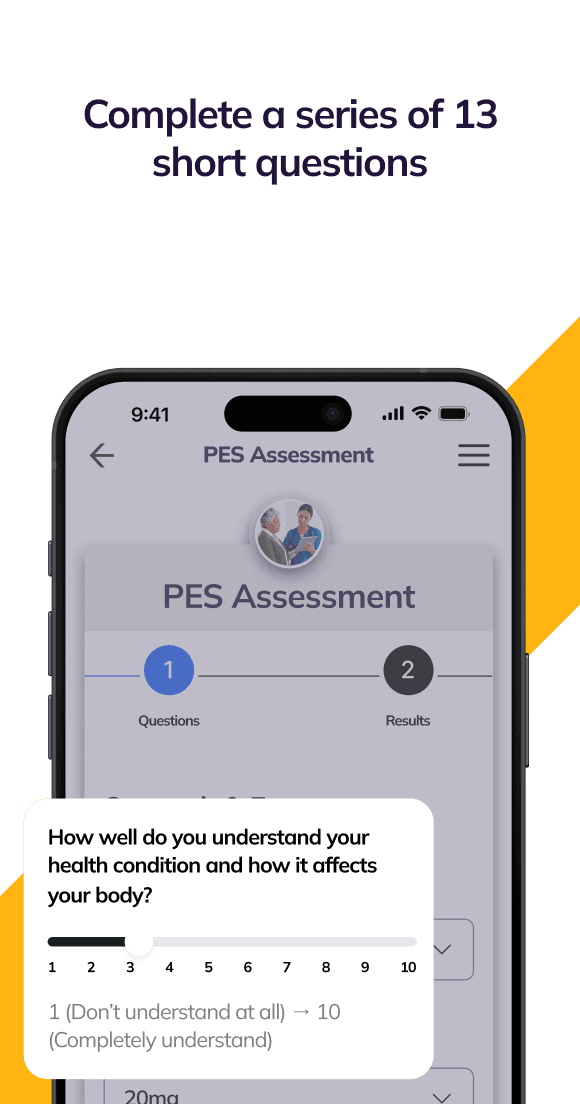
The PES assesses four interconnected domains through 13 carefully designed questions:
Knowledge & Understanding (3 items): Your comprehension of your condition, treatment rationale, and when to seek help.
Skills & Behaviors (4 items): Your ability to perform self-care tasks including symptom monitoring, medication management, and healthcare navigation.
Confidence & Self-Efficacy (3 items): Your belief in your ability to manage health, make lifestyle changes, and communicate with healthcare providers.
Action & Engagement (3 items): Your current level of active participation in treatment, prevention behaviours, and healthcare decisions.
Why should I complete the PES assessment?
Completing the PES assessment allows NowPatient to record a baseline of your health self-management capability and tailor our services to your specific needs. It also enables us to continuously assess your health profile and determine which products or services may be suitable for you. Without a completed assessment, NowPatient cannot adjust the frequency or type of support it provides to you personally.
Is PES evidence-based?
Yes. PES has been extensively researched and developed from validated assessment frameworks that have been shown to be reliable measures of patient engagement and self-management capability.
Studies show that higher engagement level scores are associated with healthier behaviours, better health outcomes, and lower healthcare costs. The evidence base includes research from Stanford University, validated chronic disease self-management studies, and peer-reviewed publications.
Where do I find the PES assessment in my account?
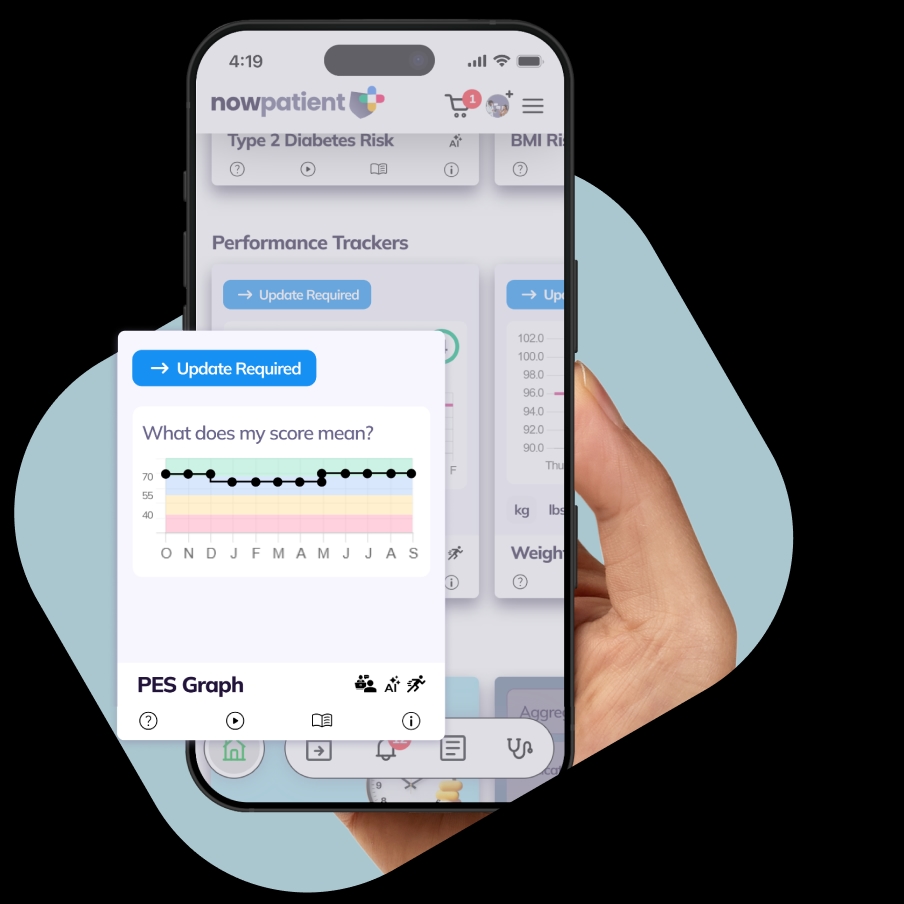
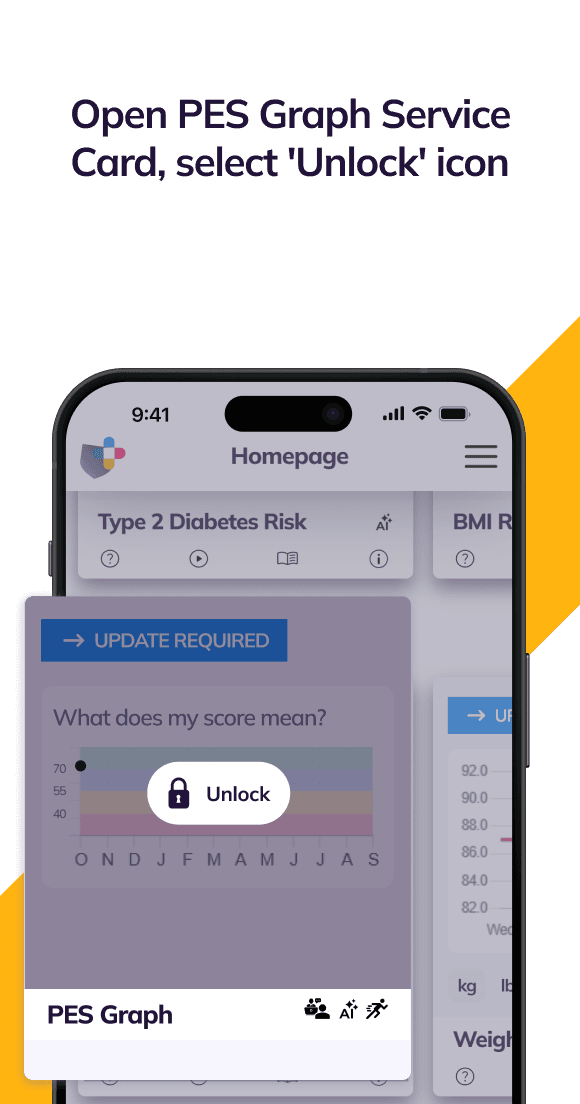
Navigate to the ‘Performance Trackers’ section of your account homepage and select the ‘PES Graph’ Service Card. If you have not completed the assessment before, the card will be locked. Select the ‘Unlock’ icon to begin the 13-question assessment.
How long does the assessment take?
The assessment consists of 13 short questions and takes only a few minutes to complete.
What type of questions will I be asked?
The 13 questions cover your knowledge of your condition, your confidence in managing your health, your self-care skills and behaviours, and your level of active engagement with your treatment and healthcare decisions.
The questions are designed to be straightforward and accessible — no specialist medical knowledge is required.
How is my score calculated?
Your responses to the 13 questions are converted to a standardised score between 0 and 100 using a proprietary formula developed by NowPatient. Based on your score, you will be classified into one of four levels: Level 1, Level 2, Level 3, or Level 4.
Will I be prompted to complete the assessment if I haven’t done so?
NowPatient recommends all users complete the assessment to establish a baseline and enable personalised support. If you file an unplanned hospital admission record in the ‘Report Hospital Admissions’ Service Card and have not yet completed a PES assessment, NowPatient will prompt you to do so.
This will trigger interventions that may help you avoid further unplanned hospital admissions.
What are the four PES levels?
Your score places you into one of four levels, each representing a different stage of health self-management capability. The higher the level, the more independently you manage your health, and the less intensive support you need from NowPatient. The lower the level, the more you are likely to benefit from more frequent, targeted support.
What does Level 1 mean?
Level 1: Building Foundation (Score 0–40) — “Not ready for self-management”
What this means:
Limited understanding of your condition
Low confidence in managing symptoms
Minimal active engagement in care
May feel overwhelmed or passive about health management
Requires significant foundational support
Support you’ll receive: Monthly personalised education and resources sent by email with intensive education focused on building foundational knowledge. Research shows approximately 15–25% of chronic disease patients begin at this level.
What does Level 2 mean?
Level 2: Developing Capability (Score 41–55) — “Becoming aware but struggling”
What this means:
Growing awareness of self-management importance
Developing knowledge but lacking confidence
Beginning to develop skills but application is inconsistent
Motivated but needs guidance and encouragement
Recognises the need for self-management
Support you’ll receive: Every 2 months personalised education and resources sent by email focused on skills training, confidence building, and structured problem-solving training. Research shows approximately 25–35% of chronic disease patients are at this level.
What does Level 3 mean?
Level 3: Actively Managing (Score 56–70) — “Taking action with growing confidence”
What this means:
Good understanding of your condition and treatment
Confident in most self-care tasks
Actively following treatment plans
Maintains consistent health behaviours
Occasional challenges with complex situations
Support you’ll receive: Every 3 months personalised education and resources sent by email focused on reinforcing successful behaviours, advanced problem-solving, and lifestyle optimisation. Research shows approximately 30–40% of chronic disease patients reach this level.
What does Level 4 mean?
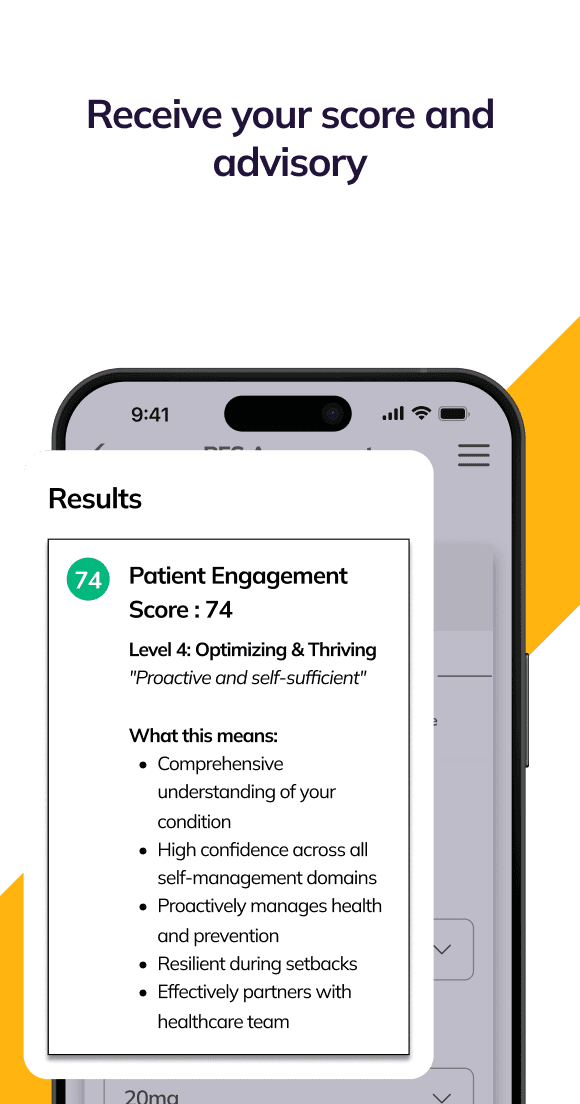
Level 4: Optimising & Thriving (Score 71–100) — “Proactive and self-sufficient”
What this means:
Comprehensive understanding of your condition
High confidence across all self-management domains
Proactively manages health and prevention
Resilient during setbacks
Effectively partners with the healthcare team
Support you’ll receive: Every year personalised education and resources sent by email with minimal support model, maintenance focus, and optimisation opportunities. Research shows approximately 15–25% of chronic disease patients achieve this level.
How often do I need to retake the assessment?
The frequency of reassessment is based on your baseline level — the level you received when you completed your first assessment:
Level 1 patients: Every 3 months
Level 2 patients: Every 4 months
Level 3 patients: Every 6 months
Level 4 patients: Annually
How will I know when it’s time to retake the assessment?
When a reassessment is due, you will see an ‘Update Required’ prompt on the ‘PES Graph’ Service Card and a notification in the ‘Notifications’ section of your account homepage. Select the ‘Update Required’ button to be taken to the reassessment page.
How can I track my progress over time?
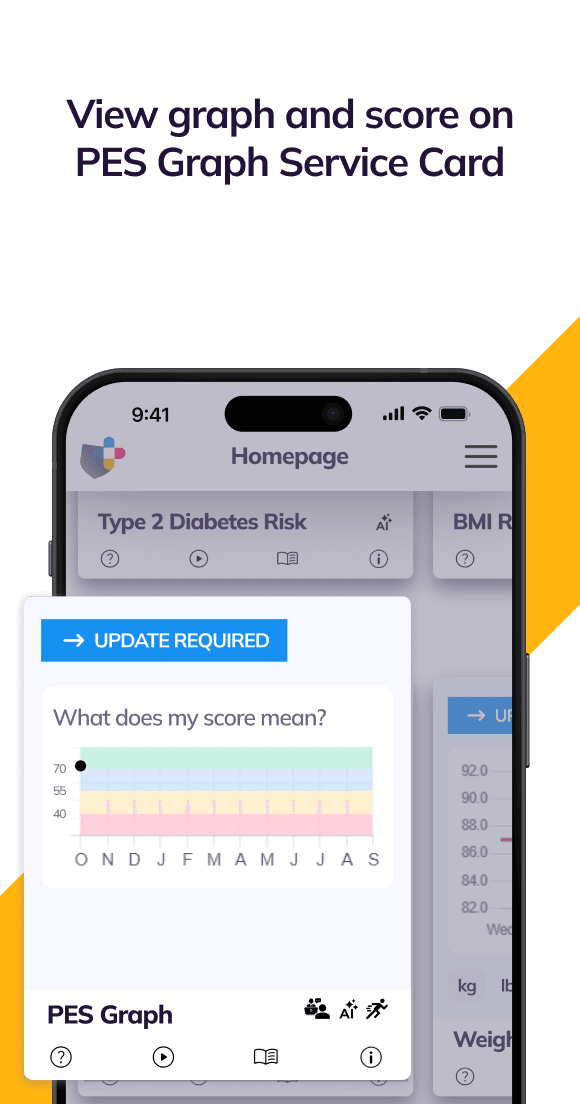
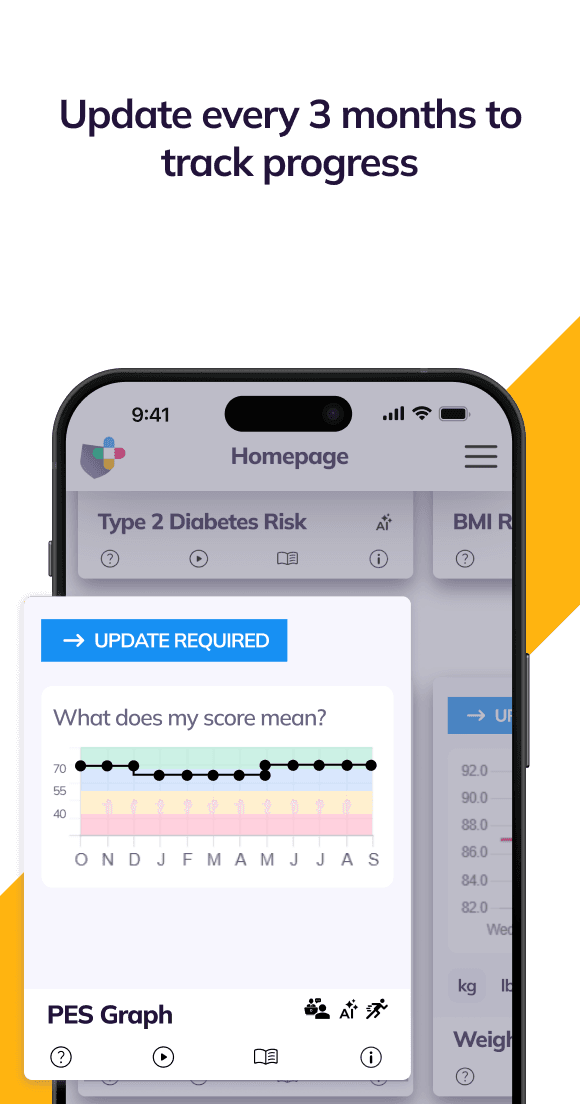
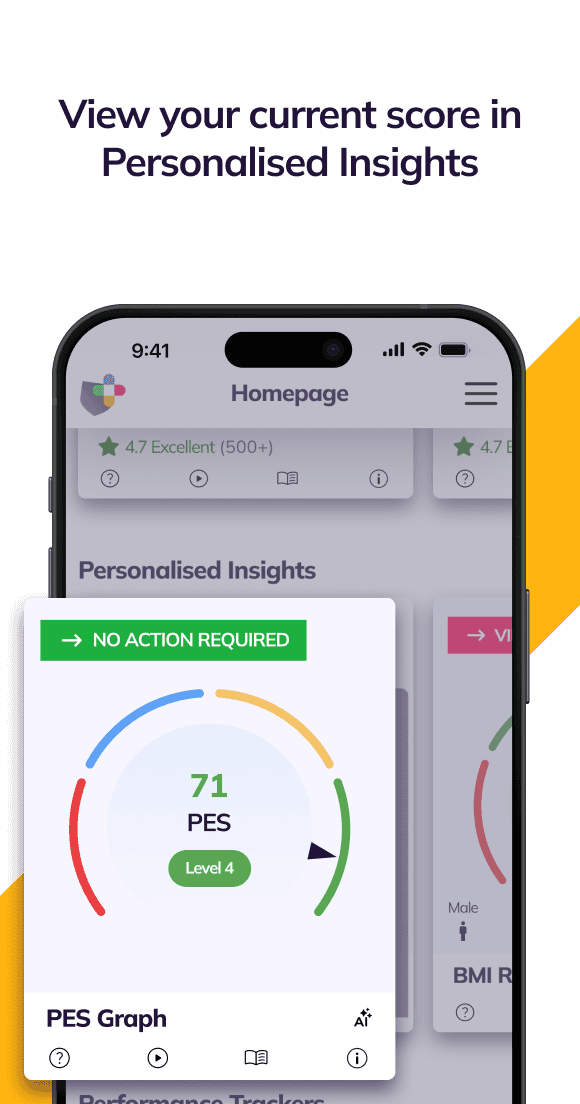
After completing or updating your assessment, navigate to the ‘PES Graph’ Service Card in the ‘Performance Trackers’ section of your account homepage. The graph is updated after every reassessment and provides a visual record of how your PES score is changing over time, making it easy to see whether your health self-management capability is improving.
What happens if my score changes level after a reassessment?
If your score moves you to a different level after a reassessment, NowPatient will adjust the frequency and content of the personalised health education and resources you receive to reflect your new level. The PES is a dynamic measure designed to grow with you as your self-management capability develops.
How does NowPatient use my PES score to personalise my experience?
NowPatient continuously assesses your health profile and PES score to predict which resources may be beneficial to you and at what frequency. For example, if you have heart disease and a lower PES score (Level 1), NowPatient will send you educational resources by email every month and may recommend community forum rooms focused on heart disease so you can access peer support.
At Level 3 or 4, you will receive less frequent touchpoints — every 3 months or annually — focused on maintaining your success and advanced problem-solving.
Can I trust the health information NowPatient sends me?
Yes. NowPatient has partnered with Drug Companies, Health Charities, and the NHS to provide health information resources covering Healthy Living, Medicines A-Z, and Conditions A-Z.
This authoritative content comes from known, trusted sources. NowPatient also publishes health-related articles written by our in-house team of clinicians, produced to standards set out in our editorial process.
What research underpins the PES?
The PES is built on five validated research frameworks:
Stanford Self-Efficacy Scales: The 6-Item Self-Efficacy for Managing Chronic Disease Scale (Lorig et al., 2001) demonstrated reliability (Cronbach’s α = 0.91) in measuring confidence across symptom control and disease management.
CanSMART Framework: Lambert et al. (2022) validated a multidimensional approach to assessing self-management with 306 participants, identifying critical domains across medical management and lifestyle modifications.
Connection to Health Model: Hessler et al. (2019) documented that patients with chronic disease experience an average of 7 concurrent self-management challenges across 12 problem areas.
Self-Management Tasks Framework: Schulman-Green et al. (2012) identified three core categories of self-management that inform the PES assessment approach.
Chronic Care Model: Wagner’s model emphasises patient self-management support as essential for effective chronic disease care (Wagner et al., 2001).
What are the key references for the PES?
Full references:
Lorig, K. R., et al. (2001). Chronic Disease Self-Management Program: 2-year health status and health care utilization outcomes. Medical Care, 39(11), 1217-1223.
Lambert, S. D., et al. (2022). The CanSMART Study: Development and validation of the Cancer Self-Management and Activation Research Tools. Psycho-Oncology, 31(3), 306-318.
Hessler, D. M., et al. (2019). A systematic review of self-management support interventions for diabetes. The Diabetes Educator, 45(6), 605-625.
Schulman-Green, D., et al. (2012). Processes of self-management in chronic illness. Journal of Nursing Scholarship, 44(2), 136-144.
Wagner, E. H., et al. (2001). Improving chronic illness care: translating evidence into action. Health Affairs, 20(6), 64-78.
Bandura, A. (1977). Self-efficacy: toward a unifying theory of behavioral change. Psychological Review, 84(2), 191-215.
Smooth, simple, seamless
Your Guide to Using the Patient Engagement Score App Feature
- Step 1.
Open PES Graph Service Card, select ‘Unlock’ icon
 1
1 - Step 2.
Complete a series of 13 short questions
 2
2 - Step 3.
Receive your score and advisory
 3
3 - Step 4.
View graph and score on PES Graph Service Card
 4
4 - Step 5.
Update every 3 months to track progress
 5
5 - Step 6.
View your current score in Personalised Insights
 6
6
SERVICE GUIDE
How Patient Engagement Score Works
What Is the Patient Engagement Score (PES)?
PES (Patient Engagement Score) is a proprietary, evidence-based clinical performance scoring system developed by NowPatient. It measures your knowledge, skills, and confidence in managing your own health and healthcare.
NowPatient uses this score to determine how often and to what extent we provide you with tailored health information and education. We base this on your knowledge, your confidence in managing your own health, and your existing use of self-management behaviours.
Patient Engagement Score is classified as a Class I medical device under UK MDR 2002 regulations for its intended use.
How to Access and Complete the PES Assessment
The PES assessment is located in the ‘Performance Trackers’ section of your account homepage. To complete it:
- Navigate to the ‘Performance Trackers’ section and select the ‘PES Graph’ Service Card on the account homepage.
- If you have not completed the assessment before, the card will be locked. Select the ‘Unlock’ icon to begin.
- Complete the series of 13 short questions.
- Receive your score and advisory. You will be classified into one of four levels (Level 1 to Level 4).
- Return to the account homepage to view your ‘PES Graph’ Service Card and track your progress over time. Update the assessment at the appropriate interval for your level.
The Four Assessment Domains
The PES assesses four interconnected domains through 13 carefully designed questions:
- Knowledge & Understanding (3 items): Your comprehension of your condition, treatment rationale, and when to seek help.
- Skills & Behaviors (4 items): Your ability to perform self-care tasks including symptom monitoring, medication management, and healthcare navigation.
- Confidence & Self-Efficacy (3 items): Your belief in your ability to manage health, make lifestyle changes, and communicate with healthcare providers.
- Action & Engagement (3 items): Your current level of active participation in treatment, prevention behaviours, and healthcare decisions.
What Does Your PES Score Mean?
After completing the 13 questions, your responses are converted to a standardised score using a proprietary formula. You will receive a score between 0 and 100 and be classified into one of four levels. The higher the score, the less targeted support you need. The lower the score, the more likely you are to benefit from more intensive support around your health condition.
Based on your score, NowPatient adjusts the frequency and methods used to proactively engage with you, providing health education and resources efficiently and in proportion to your needs.
Level 1: Building Foundation (Score 0–40)
“Not ready for self-management”
What this means:
- Limited understanding of your condition
- Low confidence in managing symptoms
- Minimal active engagement in care
- May feel overwhelmed or passive about health management
- Requires significant foundational support
Support you’ll receive: Monthly personalised education and resources will be sent by email with intensive education focused on building foundational knowledge. Research shows approximately 15–25% of chronic disease patients begin at this level.
Level 2: Developing Capability (Score 41–55)
“Becoming aware but struggling”
What this means:
- Growing awareness of self-management importance
- Developing knowledge but lacking confidence
- Beginning to develop skills but application is inconsistent
- Motivated but needs guidance and encouragement
- Recognises the need for self-management
Support you’ll receive: Every 2 months personalised education and resources will be sent by email focused on skills training, confidence building, and structured problem-solving training. Research shows approximately 25–35% of chronic disease patients are at this level.
Level 3: Actively Managing (Score 56–70)
“Taking action with growing confidence”
What this means:
- Good understanding of your condition and treatment
- Confident in most self-care tasks
- Actively following treatment plans
- Maintains consistent health behaviours
- Occasional challenges with complex situations
Support you’ll receive: Every 3 months personalised education and resources will be sent by email focused on reinforcing successful behaviours, advanced problem-solving, and lifestyle optimisation. Research shows approximately 30–40% of chronic disease patients reach this level.
Level 4: Optimising & Thriving (Score 71–100)
“Proactive and self-sufficient”
What this means:
- Comprehensive understanding of your condition
- High confidence across all self-management domains
- Proactively manages health and prevention
- Resilient during setbacks
- Effectively partners with the healthcare team
Support you’ll receive: Every year personalised education and resources will be sent by email with minimal support model, maintenance focus, and optimisation opportunities. Research shows approximately 15–25% of chronic disease patients achieve this level.
How Often Should I Retake the PES Assessment?
PES is a dynamic measure. The frequency of reassessment is based on your baseline level which is the level you received when you completed your first assessment:
- Level 1 patients: Every 3 months
- Level 2 patients: Every 4 months
- Level 3 patients: Every 6 months
- Level 4 patients: Annually
When a reassessment is due, you will see an ‘Update Required’ prompt on the ‘PES Graph’ Service Card and a notification in the ‘Notifications’ section of your account homepage.
Select the ‘Update Required’ button to be taken to the reassessment page. After completing the reassessment, your graph will update so you can visually track how you are progressing.
How Does NowPatient Use Your PES Score?
NowPatient continuously assesses your health profile and your PES score to determine which resources may be beneficial to you and at what frequency. For example, if you have heart disease and a lower PES score (Level 1), NowPatient will send you educational resources by email every month, and may also recommend community forum rooms focused on heart disease so you can access peer support. If you are at Level 3 or 4, we will provide less frequent touchpoints – every 3 months or annually – focused on helping you maintain the success of managing your own health conditions.
If you file an unplanned hospital admission record in the ‘Report Hospital Admissions’ Service Card and have not yet completed a PES assessment, NowPatient will prompt you to do so. This will trigger interventions that may help you avoid further unplanned hospital admissions.
Can I Trust the Health Information I Receive?
Yes. NowPatient has partnered with Drug Companies, Health Charities, and the NHS to provide health information resources covering Healthy Living, Medicines A-Z, and Conditions A-Z. This authoritative content comes from known, trusted sources. NowPatient also publishes a comprehensive library of health-related articles written by our in-house team of clinicians. Our editorial process sets out the standards of the content we produce.
Research Foundation
PES is built on a solid foundation of peer-reviewed research and validated assessment frameworks. Studies have shown that higher engagement level scores are associated with healthier behaviours, better health outcomes, and lower healthcare costs. The evidence base includes research from Stanford University, validated chronic disease self-management studies, and peer-reviewed publications documenting the relationship between patient self-efficacy and clinical outcomes.
The five validated frameworks underpinning the PES are:
Stanford Self-Efficacy Scales
The 6-Item Self-Efficacy for Managing Chronic Disease Scale (Lorig et al., 2001) demonstrated reliability (Cronbach’s α = 0.91) in measuring confidence across symptom control and disease management.
CanSMART Framework
Lambert et al. (2022) validated a multidimensional approach to assessing self-management with 306 participants, identifying critical domains across medical management and lifestyle modifications.
Connection to Health Model
Hessler et al. (2019) documented that patients with chronic disease experience an average of 7 concurrent self-management challenges across 12 problem areas.
Self-Management Tasks Framework
Schulman-Green et al. (2012) identified three core categories of self-management that inform the PES assessment approach.
Chronic Care Model
Wagner’s model emphasises patient self-management support as essential for effective chronic disease care (Wagner et al., 2001).
Key References
- Lorig, K. R., et al. (2001). Chronic Disease Self-Management Program: 2-year health status and health care utilization outcomes. Medical Care, 39(11), 1217-1223.
- Lambert, S. D., et al. (2022). The CanSMART Study: Development and validation of the Cancer Self-Management and Activation Research Tools. Psycho-Oncology, 31(3), 306-318.
- Hessler, D. M., et al. (2019). A systematic review of self-management support interventions for diabetes. The Diabetes Educator, 45(6), 605-625.
- Schulman-Green, D., et al. (2012). Processes of self-management in chronic illness. Journal of Nursing Scholarship, 44(2), 136-144.
- Wagner, E. H., et al. (2001). Improving chronic illness care: translating evidence into action. Health Affairs, 20(6), 64-78.
- Bandura, A. (1977). Self-efficacy: toward a unifying theory of behavioral change. Psychological Review, 84(2), 191-215.